
When Is BiPAP Used in 2025? Conditions, Signs & Breathing Support


Breathing problems are becoming more common in 2025 due to increasing air pollution, chronic lung diseases, post-COVID complications, and an aging population. Many patients struggle to breathe properly even during rest or sleep. When breathing becomes weak and oxygen alone is not enough, doctors often recommend a breathing support device called a BiPAP machine.
Patients and caregivers frequently ask:
When is BiPAP used in 2025?
What signs show that a patient needs BiPAP?
Is BiPAP used instead of oxygen?
Can BiPAP be used at home safely?
Is BiPAP suitable for elderly patients?
👉 For BiPAP machine support at home, explore our services here: BiPAP Machine on Rent – Healthy Jeena Sikho
Important Safety Note
BiPAP machines are medical devices and must be used carefully.
Always use BiPAP only on a doctor’s prescription
Never change pressure settings on your own
Do not start or stop BiPAP without medical advice
Always take proper training before home use
⚠️ This blog is for education and awareness only, not for self-treatment.

What Is a BiPAP Machine?
BiPAP stands for Bilevel Positive Airway Pressure.
A BiPAP machine helps patients breathe by delivering pressurized air through a mask. Unlike oxygen therapy, BiPAP actively supports breathing using two pressure levels:
Higher pressure during inhalation (IPAP) – helps air enter the lungs
Lower pressure during exhalation (EPAP) – makes breathing out easier
This dual-pressure system reduces breathing effort, improves airflow, and prevents respiratory fatigue.
When Is BiPAP Used in 2025?
In 2025, BiPAP is used when a patient cannot breathe effectively on their own and needs extra support to maintain normal oxygen and carbon dioxide levels.
BiPAP is commonly used when:
Breathing is labored or very difficult
Oxygen therapy alone is not effective
Carbon dioxide levels are high
Respiratory muscles become weak
There is risk of respiratory failure
Doctors recommend BiPAP when breathing problems are moderate to severe but invasive ventilators are not yet required.
Common Medical Conditions Where BiPAP Is Used
1. COPD (Chronic Obstructive Pulmonary Disease)
COPD causes airflow obstruction and air trapping. BiPAP helps reduce breathing effort, improves ventilation, and balances oxygen and carbon dioxide levels.
2. Respiratory Failure
When lungs cannot maintain proper gas exchange, BiPAP provides non-invasive ventilation and helps prevent worsening of the condition.
3. Post-COVID Lung Weakness
Many patients in 2025 continue to experience long-term lung damage after COVID-19. BiPAP helps improve breathing strength and reduces fatigue.
4. Severe Sleep Apnea
In advanced sleep apnea, breathing repeatedly stops during sleep. BiPAP keeps airways open and improves sleep quality.
5. Neuromuscular Disorders
Conditions that weaken breathing muscles, such as muscular dystrophy or nerve disorders, often require BiPAP for breathing support.
6. High Carbon Dioxide Levels (Hypercapnia)
BiPAP improves ventilation and helps remove excess carbon dioxide from the body.

Key Signs That Indicate BiPAP Is Needed
Doctors look for specific warning signs before starting BiPAP therapy.
Common signs include:
Severe shortness of breath even at rest
Rapid or shallow breathing
Low oxygen saturation despite oxygen support
Morning headaches (sign of high CO₂ levels)
Extreme tiredness due to breathing effort
Disturbed sleep because of breathing difficulty
If these symptoms appear, BiPAP may be required to prevent respiratory failure.
When Is BiPAP Used Instead of Oxygen Therapy?
Oxygen therapy and BiPAP serve different purposes.
Oxygen therapy increases oxygen levels
BiPAP supports the breathing process itself
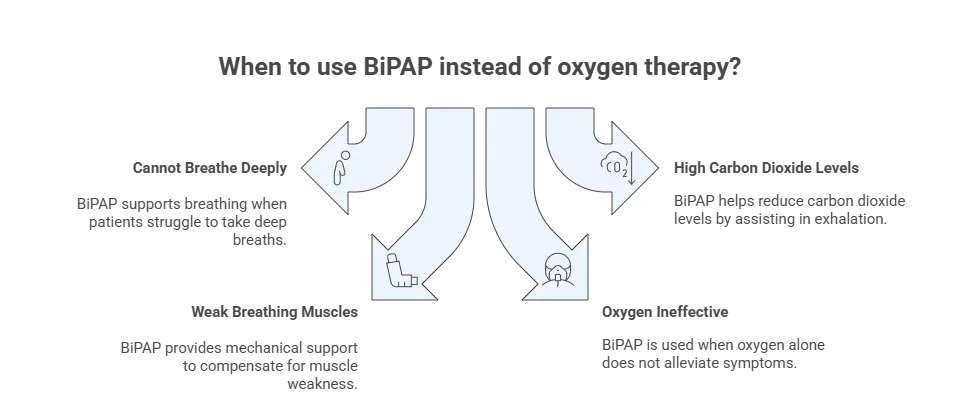
BiPAP is used instead of oxygen when:
The patient cannot breathe deeply
Carbon dioxide levels remain high
Breathing muscles are weak
Oxygen alone does not improve symptoms
In some cases, doctors prescribe BiPAP with oxygen for better results.
What Are BiPAP Machines Used For?
BiPAP machines provide non-invasive positive pressure ventilation.
They are used to:
Support weak respiratory muscles
Reduce breathing effort
Improve oxygen and CO₂ balance
Prevent emergency hospital admissions
Reduce ICU stays
Improve patient comfort and quality of life
Because of these benefits, BiPAP will be widely used in hospitals and home care in 2025.
Can BiPAP Be Used at Home in 2025?
Yes, BiPAP is commonly used at home under medical guidance.
Home BiPAP therapy is safe when:
Prescribed by a doctor
Installed by trained professionals
Patient and caregiver receive proper training
Regular monitoring and follow-ups are done
Home use allows recovery in a familiar environment and reduces repeated hospital visits.
How to Use a BiPAP Machine Safely?
To ensure safe BiPAP use:
Use the correct mask size
Place the machine on a stable surface
Follow doctor-prescribed pressure settings
Clean mask and tubing daily
Use humidifier to reduce dryness
Attend regular medical check-ups
🚫 Never adjust pressure settings without medical advice.
There is no single best BiPAP machine for everyone.
The right machine depends on:
Patient’s medical condition
Breathing requirements
Comfort needs
Doctor’s prescription
Popular BiPAP features in 2025:
Auto-adjusting pressure technology
Built-in humidifier
Quiet operation
Therapy data tracking
Oxygen compatibility
At Healthy Jeena Sikho, we provide doctor-recommended, well-maintained BiPAP machines with full training and support.
Benefits of Early BiPAP Use
Starting BiPAP at the right time offers many advantages:
Reduces breathing stress and fatigue
Improves sleep quality
Prevents condition from worsening
Reduces emergency hospital admissions
Supports faster recovery at home
Frequently Asked Questions (FAQs)
When is BiPAP used for breathing support? When breathing problems are moderate to severe and oxygen alone is not enough.
Is BiPAP safe for elderly patients? Yes, when used under medical supervision.
Is BiPAP better than CPAP? BiPAP is better for serious breathing problems; CPAP is mainly for sleep apnea.
Can BiPAP prevent ventilator use? Yes, early BiPAP use can reduce the need for invasive ventilators.
Conclusion
Understanding when BiPAP is used in 2025 helps patients and families take timely and confident healthcare decisions. BiPAP provides advanced, non-invasive breathing support for patients with weak lungs, chronic respiratory diseases, and breathing failure. When used correctly under medical guidance, BiPAP improves breathing comfort, sleep quality, and overall quality of life.
💚 Healthy Jeena Sikho – Because every breath matters.


FB Transcript Generator tools use AI to automatically convert speech from Facebook videos into accurate text transcripts. They generate captions quickly, making it easier to read, search, translate, and repurpose video content.
An aplicación para editar fotos y videos is perfect for modern content creation I like how everything can now be edited in one place with simple and smooth tools.
The results often look stylish and professional with minimal effort.
Very useful for digital creators and social media users.
Appointment PSA Gov PH is the official online appointment portal of the Philippine Statistics Authority, where you can schedule a visit to request important civil registry documents such as birth certificates, marriage certificates, death certificates, and CENOMAR. The appointment booking process is completely free, and users can choose their preferred PSA outlet, date, and time slot online. After confirming the appointment, a QR-coded appointment slip is sent to the registered email address and must be presented during the visit.
A PR portal login refers to accessing an online system used for managing permanent residency (PR) applications and related services. These portals are usually provided by government immigration departments, allowing users to securely sign in using their credentials to check application status, upload documents, and receive important updates. The portal helps applicants stay informed and manage their PR process without needing to visit offices physically.
The line about oxygen alone not being enough does a lot of quiet work here. You make BiPAP feel less like a generic breathing aid and more like a threshold where support has to be I also ended up opening Dollar General circulars afterward because it carries the same thread a little further.