
Oxygen Concentrator vs Oxygen Cylinder — Which Is Better for Home Oxygen Therapy? (2025)


When a family member starts struggling with breathing or low oxygen levels, doctors often recommend oxygen therapy - and immediately the question arises: should you choose an oxygen concentrator or an oxygen cylinder?
Both devices deliver oxygen. But they work differently, cost differently, and suit different situations. Choosing the wrong one can mean unnecessary expense, inconvenience, or a gap in care during an emergency.
This guide gives you a straight comparison - how each device works, what it costs, where each one wins, and exactly which patients should use which.
Quick Answer - Concentrator or Cylinder?
Your situation | Best choice |
Daily long-term oxygen therapy (COPD, asthma, post-COVID) | |
Emergency or power-cut backup | |
Travelling or moving outdoors | |
Short-term post-hospital recovery | ✅ Cylinder on Rent |
Both daily therapy + emergency backup | ✅ Concentrator + Cylinder together |
What Is an Oxygen Concentrator?
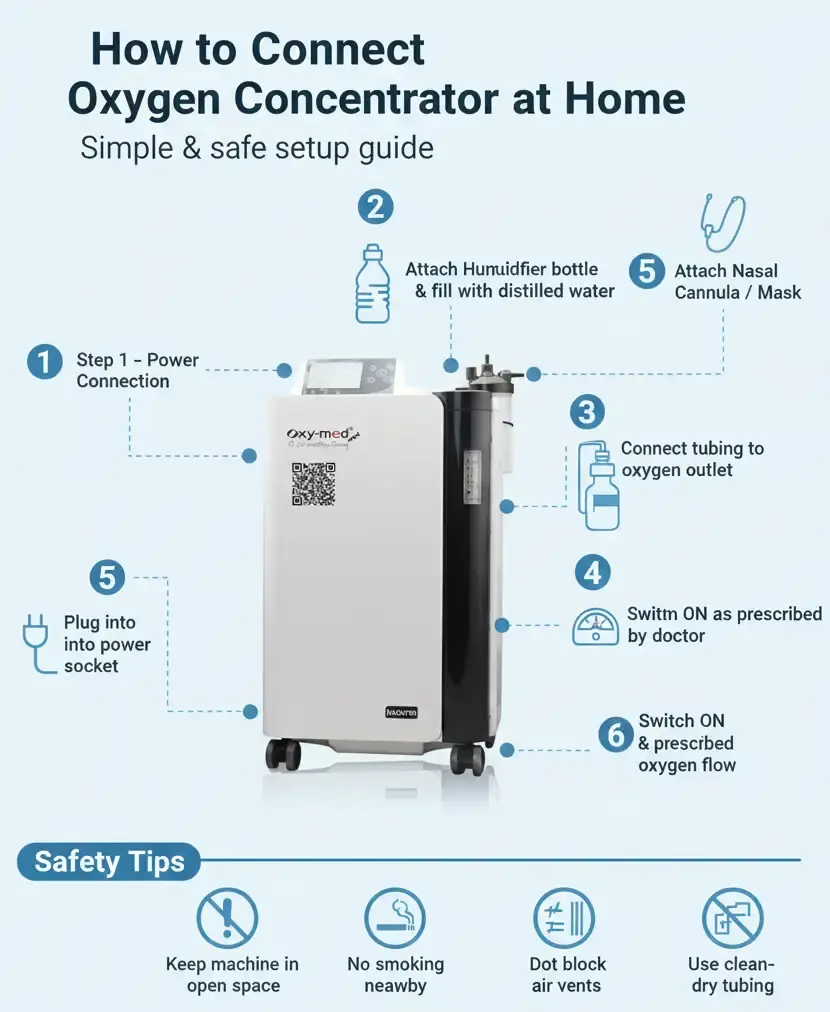
An oxygen concentrator is an electrically-powered device that pulls air from the room, removes nitrogen, and delivers purified oxygen - continuously - through a nasal cannula or mask.
It does not store oxygen. It generates it on demand.
Oxygen purity: 90–96% (medical grade) Flow range: 1–10 litres per minute depending on model Power requirement: Standard 220V electricity supply
Because it produces oxygen continuously without refilling, a concentrator is the go-to choice for patients who need oxygen every day - COPD, chronic asthma, lung fibrosis, post-COVID recovery, and sleep apnea with low SpO2.
What Is an Oxygen Cylinder?
An oxygen cylinder is a metal tank pre-filled with compressed medical-grade oxygen under high pressure. Unlike a concentrator, it does not generate oxygen - it stores a fixed amount that depletes as the patient uses it.
Once empty, the cylinder must be refilled or replaced.
Oxygen purity: 99%+ (pure compressed oxygen)
Duration: Depends on cylinder size and flow rate (a 10L cylinder at 2 LPM lasts approximately 50 hours)
Power requirement: None
Cylinders are fastest to set up and work without electricity, making them invaluable for emergencies, ambulance transport, and as backup support when the power goes out.
Oxygen Concentrators Available at Healthy Jeena Sikho
Product | Rent | sale | Best For | Type |
4500 | 39,000 | Daily home therapy, elderly patients | Stationary | |
6000 | 52,000 | High-flow needs, severe COPD | Stationary | |
- | 148,000 | Travel and outdoor mobility | Portable | |
4500 | 44,000 | Long-term reliable home therapy | Stationary | |
30,000 | 255,000 | Active patients, frequent travel | Portable | |
3500 | 43,000 | High-flow intensive therapy | Stationary | |
- | 38,000 | High-flow needs | Stationary |
Oxygen Cylinders Available at Healthy Jeena Sikho
Product | Rent | Sale | Size | Best For |
_ | 10,500 | 4.6L | Travel and short-term backup | |
_ | 15,000 | 6.8L | Home emergency backup | |
_ | 14,000 | 4.6L | Lightweight portable backup | |
_ | 18,000 | 6.80L | Home emergency use | |
4000 | 18,000 | 47L | Long-duration or hospital use | |
2000 | 12,000 | 10L | Post-hospital recovery — ₹2,000/month | |
_ | 14,000 | 4.6L | Home emergency use |
📞 Call +91 98769 78488 for refill services, delivery, and rental availability across Delhi NCR · Chandigarh ·Mohali ·Noida ·Gurgaon ·Ludhiana · Jalandhar · Jaipur · Lucknow
Full Comparison — Oxygen Concentrator vs Oxygen Cylinder
Feature | Oxygen Concentrator | Oxygen Cylinder |
Oxygen source | Generates from room air | Pre-filled compressed oxygen |
Supply duration | Unlimited (while plugged in) | Limited — empties and needs refill |
Electricity needed | Yes | No |
Refill required | Never | Yes — recurring cost |
Best for | Long-term daily therapy | Emergency and backup use |
Running cost | Low — electricity only | High — repeated refill charges |
Portability | Portable models available | Portable but heavy |
Safety at home | High — no pressurised gas | Requires careful handling |
Noise | Mild operational hum | Silent |
Setup time | 2–3 minute warm-up | Instant |
Maintenance | Low | Cylinder management + refills |
Ideal patient | COPD, asthma, sleep apnea | Emergency patients, short-term needs |
Which Is Better for Home Oxygen Therapy?
For daily, long-term use: oxygen concentrator wins clearly.
The core reason is continuous supply without the recurring cost and logistics of refilling cylinders. For a COPD patient using 2 litres per minute for 16 hours a day, a cylinder would empty every 2–3 days. That means 10–15 refills per month — expensive, stressful, and logistically difficult.
A concentrator eliminates all of that. Plug it in, set the flow rate, and it runs indefinitely.
For emergency backup: the cylinder is irreplaceable.
Concentrators stop working during power cuts. In a respiratory emergency at 2AM with no electricity, a cylinder is the difference between a manageable situation and a crisis.
The recommendation most respiratory care specialists give: use a concentrator as your primary device and keep a cylinder at home for backup.
Benefits of an Oxygen Concentrator
Unlimited oxygen supply — No refills, no running out mid-night, no logistics stress
Lower long-term cost — Pay once (or rent monthly), then only electricity bills
Safer for home use — No high-pressure compressed gas in the house
Modern features — Digital display, oxygen purity indicator, adjustable flow, low-noise motors
Portable options available — Battery-powered models for travel and outdoor use
Benefits of an Oxygen Cylinder
No electricity needed — Works during power cuts, ideal for emergency use
Instant oxygen — No warm-up time, immediate delivery on connection
Higher purity — 99%+ pure oxygen vs 90–96% from concentrators
Reliable backup — Essential safety net for any concentrator user
Portable — Smaller cylinders are easy to take in ambulances or for travel
Limitations of Each
Oxygen Concentrator limitations:
Stops working without electricity (requires power backup for 24×7 use)
Produces mild operational noise (modern models are much quieter)
Initial purchase cost is higher than a cylinder
Oxygen Cylinder limitations:
Requires frequent refilling - recurring cost and inconvenience
Heavy to move - traditional large cylinders are difficult for elderly caregivers
Must be stored and handled carefully - compressed gas is a fire and explosion hazard
Supply runs out at the worst times if not monitored
Signs You May Need Oxygen Therapy at Home
Consult your doctor and consider oxygen therapy if you experience:
SpO2 consistently below 90% on pulse oximeter
Shortness of breath during normal activities or rest
Waking up gasping or breathless at night
Chest tightness and fatigue throughout the day
COPD flare-ups becoming more frequent
Post-COVID breathing complications persisting beyond 4 weeks
You can monitor your oxygen saturation daily using a pulse oximeter at home. If your readings are consistently below 94%, discuss oxygen therapy options with your doctor.

Frequently Asked Questions
Q1. Is an oxygen concentrator better than an oxygen cylinder for home use?
For daily long-term oxygen therapy at home, an oxygen concentrator is generally better — it provides continuous oxygen without refills, is safer to store, and costs less over time. Oxygen cylinders are better as emergency backup when electricity is unavailable.
Q2. Can I use an oxygen concentrator 24 hours a day?
Yes. Most home oxygen concentrators are designed for continuous 24-hour use. Ensure the device has proper ventilation around it and follow the manufacturer's guidelines. Connect it to a power backup (UPS or inverter) to ensure uninterrupted supply during power cuts.
Q3. How long does an oxygen cylinder last at home?
Duration depends on cylinder size and flow rate. A 10L cylinder at 2 LPM lasts approximately 50 hours. A 6.8L portable cylinder at 2 LPM lasts around 34 hours. For patients using oxygen daily, cylinders alone become expensive and impractical.
Q4. Which oxygen concentrator is best for COPD patients in India?
For most COPD patients requiring 1–5 LPM, the Philips Everflo or Oxymed Mini are widely recommended for reliability and ease of use. Patients needing higher flow (5–10 LPM) should consider the Oxymed 10L or Niscomed 10L. Always confirm the flow requirement with your pulmonologist.
Q5. Can I rent an oxygen concentrator in Delhi, Gurgaon, or Noida?
Yes. Healthy Jeena Sikho offers oxygen concentrators on rent across Delhi NCR, Noida, Gurgaon, Faridabad, and Ghaziabad. Call +91 98769 78488 for current rental pricing and same-day delivery availability.
Q6. Do I need a doctor's prescription for an oxygen concentrator?
In India, medical-grade oxygen concentrators are recommended for use under medical supervision. While a prescription is not always legally mandatory for purchase, your doctor's guidance on the required oxygen flow rate (LPM) is essential for choosing the right device and using it safely. expert consultation, product support, and doorstep delivery across India.
Contact Healthy Jeena Sikho
Website: https://www.healthyjeenasikho.com/
Call Support: +91 9876978488


I like using an instagram reel downloader because it makes saving reels much easier and more organized. Whenever I discover interesting content, I can quickly download it and watch it later without scrolling through my feed again.
As someone who's navigated the complexities of home oxygen therapy, I can say choosing between an oxygen concentrator and a cylinder is pivotal! It's like selecting the right gear in hot games strategy is key! Each has unique benefits that align with lifestyle needs. Your insights really highlight their impact on daily living. Thank you for shedding light on this vital topic!
This article provides a crucial comparison for selecting reliable home oxygen therapy equipment, emphasizing that performance and dependability are paramount for health. Such vital systems rely on foundational components working flawlessly, much like a precisely engineered WellPCB is essential for any critical electronic device to function correctly.