
How to Rent an Oxygen Concentrator for Travel

Planning a trip with oxygen can feel stressful, especially when a flight, battery plan, or rental deadline is involved. The right portable oxygen concentrator rent for travel plan starts with your prescription, then moves through airline approval, power needs, delivery, and safe use.
We help families at Healthy Jeena Sikho arrange medical equipment rentals across 15 cities in North India. Use these steps before you book, so your equipment is ready before you leave.
Table of Contents
Step 1: Confirm Your Prescription and Travel Requirements
Start by asking your treating doctor whether you can travel and what oxygen setting you need. A portable oxygen concentrator must match your prescription, not just your luggage plan.
Ask the doctor to confirm the prescribed flow and whether you need pulse-dose or continuous-flow oxygen . Pulse-dose machines deliver oxygen when the device senses an inhalation. Continuous-flow machines deliver oxygen at a steady rate. These modes are not interchangeable, so do not change between them without clinical advice.
Ask about the full journey, too. A short car ride to the airport may be easy, while a long flight, road trip, or high-altitude holiday may place different demands on your breathing. The doctor should decide whether your current setting remains suitable for the trip.
Then write down the details a rental team will need:
Your prescribed mode and flow.
How long you expect to stay away from a power socket.
Whether you will fly, drive, take a train, or use more than one form of travel.
Your destination, travel dates, and delivery address.
Any mobility needs, such as a carry bag or wheeled support.
Weight matters. A small device may be easier for airport walks, while a larger unit may suit a prescription that needs continuous flow. A lighter unit can help on a family visit or road journey, but only if it supports the prescribed therapy.
Healthy Jeena Sikho's portable oxygen concentrator rental option can be checked against your prescription and travel dates. Current rental pricing varies by city, model, and term, so confirm the product page details before booking.
Do not choose a device because it looks powerful. Choose one that your doctor has cleared for your actual use.

Step 2: Check Airline Approval and Prepare the Paperwork
For air travel, confirm both device acceptance and airline approval before you pay for a rental. A portable oxygen concentrator that meets applicable DGCA requirements may still require the airline's own forms and advance notice.
Contact the airline as soon as you know your flight date. Ask for its current medical equipment policy. Confirm whether you need a medical clearance form, a doctor's letter, or a specific approval form for the exact device model.
Many airlines ask for details such as:
The device make and model.
The unit's serial number.
The serial number of each battery.
Your prescribed oxygen flow and mode.
A doctor's signature or medical clearance.
Some travel guidance recommends giving the airline about two weeks' notice. Treat that as a planning target, not a universal rule. Your airline may set a different deadline, and its written policy takes priority.
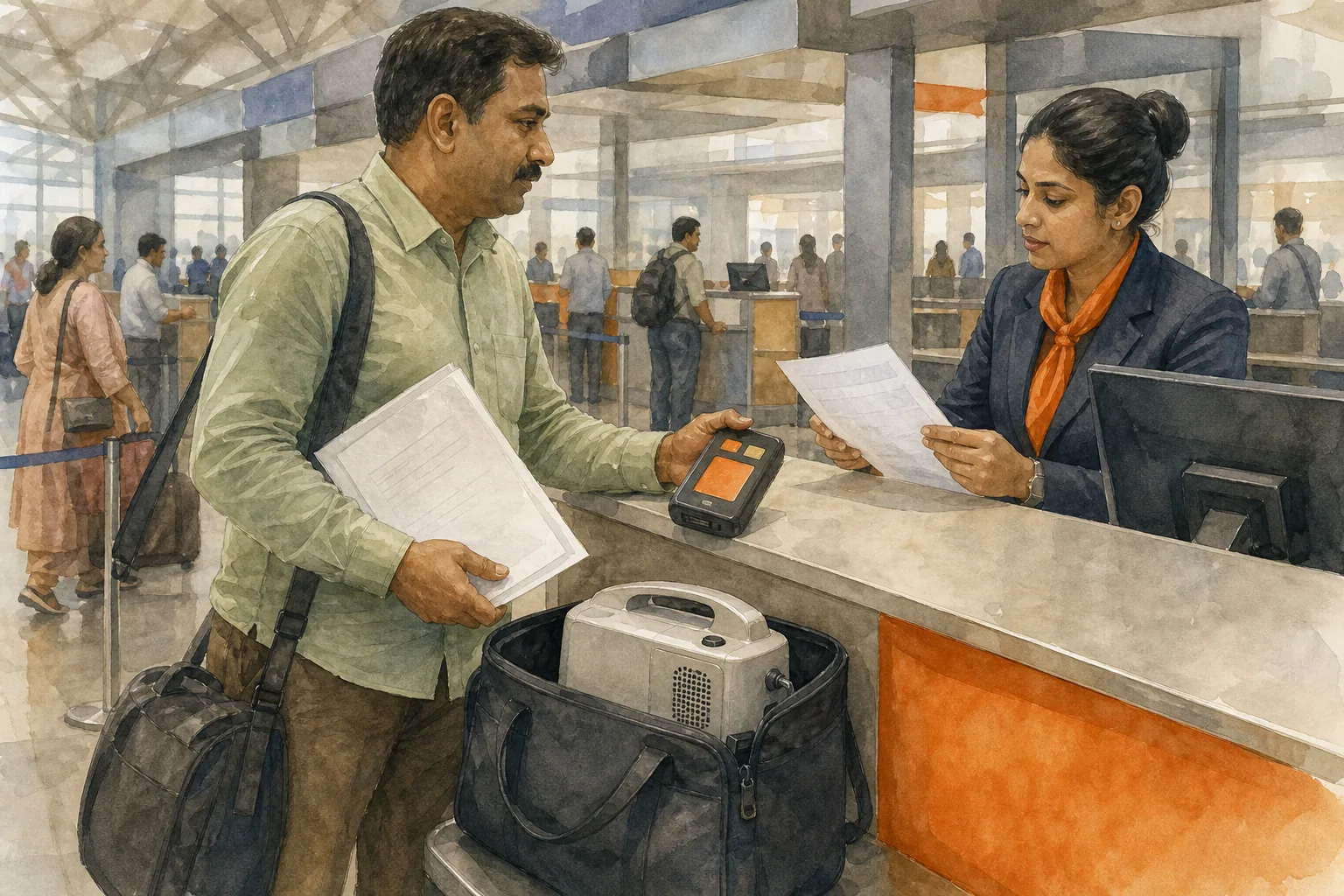
Keep copies of the approval email and completed forms in your cabin bag. Save a digital copy on your phone, but don't rely on the phone alone. A printed copy is useful during check-in, security checks, and a connection.
Airline staff may also ask you to show that the device is safe to carry and that you can manage it during the flight. Ask where it may be stored during take-off and landing. Don't assume an aircraft power socket will be available or suitable.
Manufacturer guidance for some portable oxygen devices also points travellers to separate travel and safety instructions, so check the exact model documents supplied with your rental. You can review current DGCA travel guidance and the manufacturer's instructions for the kind of operating information required.
At Healthy Jeena Sikho, share the airline's form with us before dispatch if it asks for model or serial details. That gives us time to confirm the equipment information instead of leaving the issue for airport day.
Step 3: Plan Batteries for Flights, Cars and Holiday Trips
Battery planning is the part many travellers underestimate when arranging a portable oxygen concentrator rental for travel. Count the whole journey, not only the time in the air.
Use a 150% planning rule for flights. If the expected flight time is four hours, plan at least six hours of battery capacity. Add the time spent reaching the airport, checking in, waiting at the gate, boarding, taxiing, changing planes, and dealing with delays. Check the airline’s requirements and current DGCA guidance before travelling.
Airline staff may not let you depend on an aircraft power socket. Carry batteries in your cabin baggage, not checked luggage. Protect the battery terminals from metal objects, and keep each battery in good working condition.
Before leaving home, ask the rental team:
How long the battery should last at your prescribed setting.
How many batteries match your full journey.
Whether spare batteries are available for rent.
Which charger is for home use.
Whether a vehicle DC adapter is included or available.
For a car trip, ask whether the unit can run or charge through the vehicle's auxiliary outlet. Keep the concentrator secure and leave its air vents clear. Never place it under luggage or against a hot surface.
Holiday travel needs the same care. A family home may have power cuts, busy rooms, or limited sockets. Plan a place where the machine can stay upright with clear airflow. If you are travelling to a hill station or another high-altitude area, ask your doctor whether the trip changes your oxygen needs.
Battery performance depends on the device, setting, and conditions. The official device information may list different power sources and operating limits, so use the information supplied with your rental rather than relying on a general estimate. Manufacturer specifications for portable oxygen equipment show why AC, vehicle DC, and battery use must be checked for the exact model.
Key Takeaway:Plan 150% of expected flight time, then add airport delays and ground travel before deciding how many batteries you need.
Step 4: Arrange the Rental, Delivery and Return Plan
Book the rental only after you know the prescription, dates, destination, and travel method. A clear handoff plan matters as much as the machine itself.
Give the rental team the full schedule. Include your departure date, return date, delivery address, and the time you need the unit. Ask for delivery before travel day so you can test the device at home.
Do not plan for the machine to arrive a few hours before a flight. A late parcel can leave you without time to check the battery, charger, cannula, or operating instructions. Ask what happens if delivery is delayed and which support route you should use.
Confirm the rental scope in writing. Ask if the booking includes:
The concentrator and its carry case.
The main charger and any vehicle adapter.
Battery units for your approved travel plan.
A nasal cannula or other listed accessories.
Instructions for damage, faults, and returns.
Pricing is dynamic. It can change with the city, model, and rental term. Healthy Jeena Sikho provides rentals in its 15-city North India network, while equipment sales are available across India. Current pricing is listed on the Philips Simply Go Mini portable oxygen concentrator rental product page , so check the exact term before confirming.
Our service network includes Delhi, Noida, Greater Noida, Ghaziabad, Faridabad, Gurgaon, Lucknow, Jaipur, Ludhiana, Jalandhar, Bathinda, Chandigarh, Mohali, Panchkula, and Ambala. Four-hour express delivery is available in many locations, but availability depends on the city and requirement.
Write down the return date before your trip starts. Keep the original packaging if the rental team asks you to use it. Ask whether the return is collected or whether you must drop the parcel at an approved location.
Pro Tip:Put the delivery date, flight date, return date, and rental support details in one note shared with the family member managing the trip.
Step 5: Test the Unit and Travel Safely
Test the rental at home before travel day. You should know how to start it, charge it, carry it, and respond to a warning.
Check the unit as soon as it arrives. Look for visible damage. Confirm that the model and serial number match the paperwork. Charge each battery fully, then test the machine at the setting prescribed by your doctor.
Ask the rental team to explain any alarm, error message, or battery warning. Do not change the flow because the device feels different from your home machine. If the unit does not seem to work as expected, stop and seek help before travelling.
During use, keep the air inlet and outlet clear of walls, bedding, curtains, and luggage. The concentrator needs airflow. Carry spare cannulas and the correct charger in your cabin baggage or day bag.
Oxygen supports combustion. Never smoke or use the machine near a candle, gas stove, diya flame, incense, lighter, or any open flame. Keep the device away from heat. Tell travel companions about this rule.
On a flight, follow the airline's instructions for storage and use. Keep the concentrator within reach when permitted. Do not place it in checked luggage. During a car trip, secure it so it will not fall or block the driver's controls.
For a holiday stay, choose a dry, clean area with a nearby power socket. Do not cover the unit with a cloth. If the device stops, the battery runs low, or your breathing worsens, follow your clinician's emergency plan and seek medical help.
We also recommend reading our guidance on air travel with oxygen therapy before you submit airline paperwork. It can help you prepare questions for the airline and rental team.
Frequently Asked Questions
Can I take a rented oxygen concentrator on a flight?
You can take a rented oxygen concentrator on a flight only after confirming that the exact device is accepted and the airline approves your travel plan. Ask about advance notice, medical forms, battery rules, and storage. Carry the unit and batteries in your cabin baggage unless the airline gives different written instructions.
How many batteries do I need for a flight?
Plan battery capacity for at least 150% of the expected flight time, then add airport waiting time and possible delays. A four-hour flight therefore needs about six hours of planned battery capacity. Your prescribed setting affects runtime, so the rental team must confirm the battery plan for your exact unit.
Can I use a portable oxygen concentrator in a car?
You can use a portable oxygen concentrator in a car if the device and vehicle adapter support it. Ask whether the unit can run from the vehicle's auxiliary outlet. Secure the machine, keep its vents clear, and never let the driver handle controls while moving. Carry enough battery power for traffic or a power failure.
How early should I rent an oxygen concentrator for travel?
Arrange the rental as soon as your doctor clears the trip and your dates are known. For flights, start airline approval early because forms may need medical signatures and device serial numbers. Ask for delivery before travel day, leaving time to test the machine and resolve any issue.
What should I ask before renting a portable oxygen concentrator?
Ask whether the unit matches your prescription, whether it uses pulse-dose or continuous flow, and whether the airline accepts that model. Confirm battery runtime, spare battery access, chargers, delivery timing, support for faults, and the return process. Also ask for current pricing based on your city and rental term.
For a temporary trip, renting is usually more sensible than buying equipment you may not use often. First get medical clearance, then confirm the airline and battery plan. When you're ready, send your travel dates and prescription details to Healthy Jeena Sikho through the relevant rental page so we can check availability and delivery for your location.


Comments