
Home Sleep Apnea Test: Cost, Process & When to Consider a BiPAP Machine
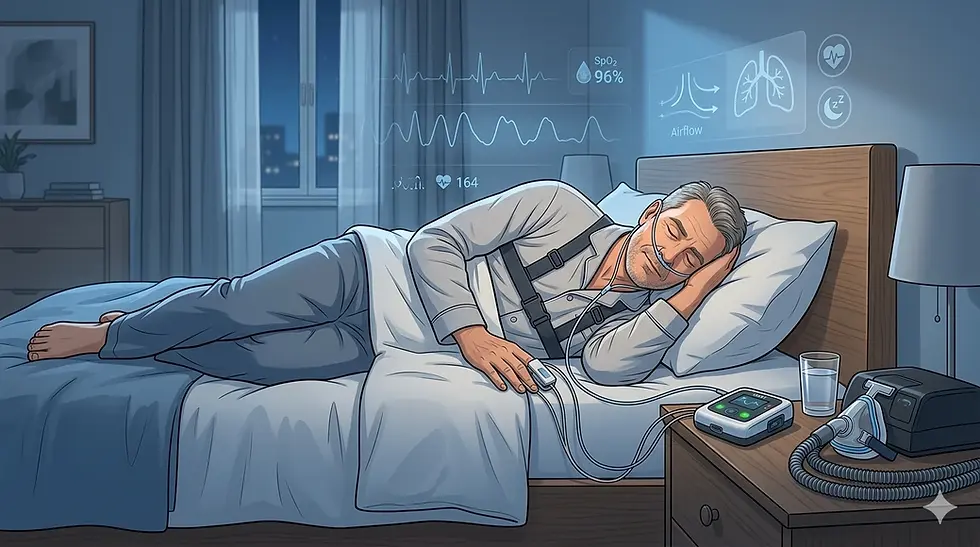
You wake up every morning feeling like you barely slept. Your partner nudges you through the night because your snoring wakes them up — or worse, because you stopped breathing altogether. You drag yourself through the day on coffee and willpower, wondering why no amount of sleep ever feels like enough. If this sounds familiar, you may have sleep apnea.
The good news is that diagnosing sleep apnea no longer means spending an uncomfortable night in a hospital hooked up to wires. A Home Sleep Apnea Test (HSAT) lets you get tested in your own bed, and the entire process — from test to treatment — can be completed without much disruption to your daily life.
In this guide, we cover everything you need to know: what sleep apnea actually is, how to tell if you might have it, how a home sleep test works step by step, what it costs in India, how to understand your results, and when a doctor recommends a BiPAP or CPAP machine to treat it.
What Is Sleep Apnea — And Why You Cannot Afford to Ignore It
Sleep apnea is a condition where your breathing repeatedly stops and starts while you sleep. These breathing pauses — called apneas — each last at least 10 seconds. In moderate to severe cases, this can happen hundreds of times a night without you even being aware of it.
Each time your breathing stops, your oxygen levels drop. Your brain, sensing danger, jolts you just awake enough to resume breathing — but not awake enough for you to remember it in the morning. This cycle repeats all night, every night, leaving you chronically sleep-deprived no matter how many hours you spend in bed.
There are three types of sleep apnea:
Obstructive Sleep Apnea (OSA) is by far the most common. It happens when the soft tissues at the back of your throat — your tongue, soft palate, and surrounding muscles — relax during sleep and partially or completely collapse, blocking your airway. Your body is still trying to breathe, but no air gets through. This is the type most people are diagnosed with, and the focus of this article.
Central Sleep Apnea is less common. Here, the airway is not blocked — the problem is that your brain temporarily stops sending the signal to your breathing muscles. It is associated with heart failure, stroke, and certain medications.
Mixed or Complex Sleep Apnea is a combination of both obstructive and central apnea, and requires specialised treatment.
What untreated sleep apnea does to your body over time:
Most people dismiss sleep apnea as just a snoring problem. It is not. Left untreated, it significantly increases your risk of:
High blood pressure — one of the most direct consequences
Heart disease and irregular heart rhythms
Type 2 diabetes
Stroke
Liver problems
Chronic depression and anxiety
Car and workplace accidents due to excessive daytime sleepiness
According to the Canadian Lung Association's Sleep Apnea Handbook, people with untreated sleep apnea are at a significantly greater risk of road accidents — and in some cases, doctors have a duty to report patients who refuse treatment and continue driving.
Sleep apnea is not something you sleep off. It is a medical condition that needs diagnosis and treatment.
Could You Have Sleep Apnea? Signs and Symptoms to Watch For
The tricky thing about sleep apnea is that you are unconscious when most of it happens. Many people live with it for years before a partner, roommate, or doctor flags it.
The two primary warning signs are:
Excessive daytime sleepiness — falling asleep during conversations, while watching television, or most dangerously, while driving. This goes beyond just feeling tired. It is an inability to stay awake during normal waking hours despite getting enough hours of sleep.
Loud snoring with noticeable pauses in breathing — particularly if someone has observed you gasping, choking, or going silent mid-snore before resuming.
Other symptoms that commonly accompany sleep apnea:
- Waking up with a dry mouth or sore throat
- Morning headaches that go away within an hour or two
- Waking up frequently to urinate
- Waking with a feeling of choking or gasping
- Difficulty concentrating, forgetfulness, or brain fog during the day
- Irritability, mood swings, or symptoms of depression
- High blood pressure that is difficult to control despite medication
- Reduced libido
Many patients are diagnosed with sleep apnea only after going to a cardiologist or endocrinologist for unrelated symptoms — high blood pressure, irregular heart rate, or blood sugar issues — and the underlying cause turns out to be disrupted, oxygen-deprived sleep night after night.
Am I at Risk? Take the STOP-BANG Self-Assessment
The STOP-BANG questionnaire is a clinically validated screening tool used by doctors worldwide to assess risk for obstructive sleep apnea. Answer the following eight yes/no questions honestly:
Yes/No | Component | Question |
☐ | S – Snoring | Do you snore loudly — loud enough to be heard through a closed door, or does your partner elbow you for snoring? |
☐ | T – Tired | Do you often feel tired, fatigued, or sleepy during the day — such as falling asleep while talking or driving? |
☐ | O – Observed | Has anyone ever seen you stop breathing, choke, or gasp during your sleep? |
☐ | P – Pressure | Do you have high blood pressure, or are you currently being treated for it? |
☐ | B – BMI | Is your Body Mass Index (BMI) greater than 35? |
☐ | A – Age | Are you older than 50 years? |
☐ | N – Neck | Is your neck circumference greater than 43 cm for men, or 41 cm for women? |
☐ | G – Gender | Are you male? |
How to interpret your score:
- 0–2 Yes answers: Low risk for OSA
- 3–4 Yes answers: Intermediate risk — speak to your doctor
- 5–8 Yes answers: High risk — you should get tested as soon as possible
Being male or being over 50 alone does not mean you have sleep apnea — but combined with other factors, your risk increases substantially. Women are also at risk, particularly after menopause, and are often underdiagnosed because their symptoms can present differently.
If you scored 3 or above, do not wait. Getting a sleep test done is far simpler and more affordable than most people assume.
What Are the Risk Factors for Sleep Apnea?
Certain physical and lifestyle characteristics increase the likelihood of developing obstructive sleep apnea:

- Excess weight or obesity — fatty tissue around the upper airway narrows it and increases collapse risk during sleep
- Large neck circumference — indicates excess tissue around the airway
- Being male — men are twice as likely to have OSA as women before age 50
- Age over 50 — muscle tone in the throat decreases with age
- Family history — OSA has a genetic component
- Smoking — causes inflammation and fluid retention in the upper airway
- Recessed chin or small jaw — structural anatomy that leaves less space in the airway
- Large tonsils or adenoids — particularly relevant in children
- Certain medical conditions — hypothyroidism, PCOS, GERD, heart failure
It is worth noting that risk factors increase the probability — but sleep apnea can and does occur in people who are thin, young, female, and without any obvious anatomical risk factors. If you have symptoms, a test is the only way to know for certain.
How Is Sleep Apnea Diagnosed? Understanding Your Testing Options
There are two main types of sleep studies. Your doctor will recommend one based on your symptoms, medical history, and the complexity of your case.
Option 1: Polysomnography (PSG) — The Lab Sleep Study
A polysomnography, also called a Level 1 sleep study, is the gold standard for diagnosing sleep disorders. You spend a night at a certified sleep lab while being monitored by trained staff.
During the test, sensors placed on your body record:
- Brain wave activity (to identify sleep stages)
- Eye movements
- Heart rate and rhythm
- Blood oxygen levels
- Airflow through the nose and mouth
- Respiratory effort (chest and abdomen movement)
- Leg movements
The data is reviewed by a certified sleep physician who produces a detailed report and, if needed, recommends a treatment plan.
When a lab sleep study is necessary:
- When central or complex sleep apnea is suspected
- When you have a serious co-existing condition (heart failure, COPD, stroke, neurological disease)
- When a home test is inconclusive
- For children — paediatric sleep apnea always requires a lab study
The limitation: Waiting times in many cities can stretch to weeks or months, and the cost is higher than a home test.
Option 2: Home Sleep Apnea Test (HSAT) — Level 3 Testing
A Home Sleep Apnea Test, also referred to as HSAT or Level 3 Testing, is a simplified version of the sleep study that you perform in your own home over one or two nights.
As public awareness of sleep apnea has grown, so has the demand for accessible testing. HSAT was developed precisely to reduce the burden on hospital sleep labs and bring testing to patients who would otherwise wait months.
What an HSAT records:
- Airflow through the nose and mouth
- Breathing effort (movement of the chest and abdomen)
- Blood oxygen saturation (SpO2)
- Heart rate
- Sleep position (in some devices)
Quick comparison:
Factor | Lab Sleep Study (PSG) | Home Sleep Apnea Test (HSAT) |
Location | Hospital or sleep lab | Your own bedroom |
Convenience | Requires overnight stay | Sleep in your own bed |
Sensors monitored | 20+ parameters | 4–6 key parameters |
Accuracy | Most comprehensive | Accurate for OSA screening |
Wait time | Weeks to months | Usually within days |
Cost | Higher | More affordable |
Best suited for | All sleep disorders, complex cases | Suspected OSA in adults without other serious illness |
Important: An HSAT may slightly underestimate the severity of sleep apnea compared to a lab study, because it does not measure brain activity to confirm actual sleep time. However, for the majority of adults with suspected obstructive sleep apnea and no other serious illness, it is a reliable and doctor-approved method of diagnosis.
How a Home Sleep Apnea Test Works — Step by Step
Here is exactly what happens from the moment you decide to get tested to the moment you have a diagnosis.
Step 1: Speak to your doctor
If you have symptoms or scored 3 or above on the STOP-BANG questionnaire, speak to your family doctor. Based on your history, they will refer you for either a home test or a lab sleep study. In many cases, they will start with the home test.
Step 2: Receive the testing device
A small, portable recording device is provided to you — either collected from the clinic or delivered to your home. The kit typically includes:
- A small recording unit that clips onto your finger or chest
- A nasal cannula or airflow sensor worn under your nose
- Elastic belts worn around your chest and abdomen to measure breathing effort
- A pulse oximeter to measure blood oxygen levels
Setup is straightforward and takes about 10–15 minutes. Most devices come with illustrated instructions, and technicians are available to walk you through it over the phone.
Step 3: Sleep normally for one to two nights
Wear the device for one or two nights while sleeping in your own bed. The device records data passively — you do not need to do anything during the night. Try to sleep in your usual position and follow your normal routine. Avoid alcohol before the test as it can artificially worsen apnea and skew results.
Step 4: Return the device
Drop off the device the next morning or have it collected. The data stored on it is downloaded and sent to a sleep physician for analysis.
Step 5: Wait for your results
A certified sleep physician analyses the overnight data. Results are typically ready within three to seven days. Your doctor will call you to discuss the report.
Step 6: Receive your diagnosis and treatment plan
Your doctor explains what your results mean, how severe your sleep apnea is (if present), and what treatment is recommended — which may include CPAP therapy, BiPAP therapy, an oral appliance, lifestyle changes, or surgery in some cases.
Home Sleep Apnea Test Cost in India
Let us get straight to what most people want to know.
A home sleep apnea test in India typically costs between ₹2,500 and ₹6,000, depending on the provider, city, and what is included in the package. Healthy Jeena Sikho has bought Home Sleep Study Test - Level 3 at ₹1999.
A full lab-based polysomnography costs more — typically between ₹8,000 and ₹20,000 in most private hospitals and sleep centres, with some premium facilities charging more.
What affects the price:
- City: Metro cities like Delhi, Mumbai, and Bangalore tend to have higher pricing than tier 2 cities like Chandigarh
- Provider: Private sleep clinics vs. hospital sleep labs vs. home-service providers
- What is included: Some packages include a physician consultation and prescription as part of the cost; others charge separately
- Device delivery: Home delivery of the testing device may have an additional charge at some places
- Follow-up: Whether a post-test consultation with a sleep physician is bundled in
Does insurance cover a sleep apnea test in India?
Several health insurance policies do cover sleep studies, particularly if you have a referral from a doctor and an underlying condition like hypertension or cardiac disease. Check your specific policy or call your insurer before booking. We can also guide you on this — reach out to our team.
How to Read Your Sleep Apnea Test Results
When your results come back, the report can look technical. Here is a plain-language breakdown of what the key numbers mean.
The AHI — Apnea-Hypopnea Index
This is the single most important number in your report. The AHI tells you how many times per hour your breathing was fully stopped (apnea) or significantly reduced (hypopnea) during sleep.
AHI Score | What It Means |
Less than 5 | Normal — no sleep apnea |
5 to 14 | Mild sleep apnea |
15 to 29 | Moderate sleep apnea |
30 or above | Severe sleep apnea |
An AHI of 30 means your breathing was disrupted 30 times every hour you slept — once every two minutes. That gives you a sense of how serious a score of 30+ actually is.
Other Numbers in Your Report
SpO2 (Blood Oxygen Saturation): This measures what percentage of your blood is carrying oxygen. Normal is 95% or above. Drops below 90% during sleep are a significant clinical concern and indicate your body is being deprived of oxygen repeatedly through the night.
Oxygen Desaturation Index (ODI): How many times per hour your blood oxygen dropped by 4% or more. A high ODI alongside a high AHI confirms the severity of the condition.
Snoring Index: Records the frequency and intensity of snoring events across the night.
Positional Data: Some devices record which position you were sleeping in. OSA is typically worse when sleeping on your back — if your AHI is significantly higher in the supine position, your doctor may recommend positional therapy as part of your treatment.
Important: Your report alone does not tell you which machine or pressure setting you need. That is your doctor's job. But understanding these numbers helps you have a much more informed conversation with your physician.
When Does a Doctor Recommend a BiPAP Machine?
This is the question many people have after their diagnosis, and the answer depends on several factors.
Your doctor will recommend a CPAP machine as the first line of treatment for most cases of obstructive sleep apnea. CPAP delivers a single, steady pressure of air that keeps your airway open all night.
However, a BiPAP machine is recommended in specific situations:
1. When CPAP pressure is too high to tolerate
Some patients are prescribed high CPAP pressures to manage severe OSA. Exhaling against that constant high pressure can feel like breathing against resistance. BiPAP solves this by delivering a lower pressure on exhale (EPAP) while maintaining a higher pressure on inhale (IPAP) — making the entire breathing cycle feel far more natural and comfortable.
2. When you have moderate to severe OSA, and CPAP alone is not working
If you have been on CPAP for several weeks and your AHI data shows the therapy is not adequately controlling your apneas, your doctor may upgrade you to BiPAP.
3. When you have COPD alongside sleep apnea
Patients with Chronic Obstructive Pulmonary Disease often have difficulty exhaling fully. BiPAP's dual-pressure system actively assists both inhalation and exhalation, making it significantly more effective than CPAP for these patients.
4. When you have central or complex sleep apnea
Central sleep apnea — where the brain does not send the signal to breathe — does not respond to standard CPAP. BiPAP in spontaneous-timed (ST) mode or an Adaptive Servo Ventilation (ASV) device may be prescribed.
5. When you have a neuromuscular disease
Conditions like ALS, muscular dystrophy, or spinal muscular atrophy affect the breathing muscles. These patients need active ventilatory support that BiPAP provides.
6. When you need short-term breathing support after surgery or illness
Patients recovering at home after a hospitalisation, surgery, or a severe respiratory illness often need temporary BiPAP support — renting a machine for this period is a practical and cost-effective solution.
CPAP vs. BiPAP — a simple summary:
Feature | CPAP | BiPAP |
Pressure delivery | One fixed pressure | Two pressures — higher during inhale, lower during exhale |
Best for | Mild to moderate OSA | Moderate–severe OSA, COPD, complex apnea |
Exhale comfort | Can feel difficult at high pressures | Much easier to breathe out |
Cost | Lower | Higher |
Prescribed when the condition | First line for OSA | When CPAP fails, or for complex respiratory conditions |
Do not choose your own machine based on what you read online.
Your sleep physician prescribes your therapy type and pressure settings based on your AHI, your medical history, your body weight, and your test data. Using the wrong machine or wrong pressure will not treat your condition — and may make things worse.
What to Expect When You Start BiPAP Therapy
Starting BiPAP therapy for the first time can feel strange. That is completely normal, and it is important that you do not give up in the first few nights.
The First Few Nights
The sensation of air being pushed into your airway as you try to fall asleep is unfamiliar. Your instinct may be to pull the mask off. Here is what helps:
Use the ramp feature: Almost all modern BiPAP machines start at a low pressure and gradually increase to your prescribed setting over 20–45 minutes. This gives your body time to relax and fall asleep before the full pressure kicks in. Ask your supplier to turn this on if it is not already active.
Wear the mask while awake first: Before sleeping, sit on your bed with the machine on and just breathe normally for 15–20 minutes. This desensitises you to the sensation before you try to sleep.
Start with shorter periods: If you truly cannot tolerate a full night, use it for as long as you can and gradually increase. But the goal is to use it every single night.
Getting Your Mask Right
Your mask is the most critical element of successful therapy. A mask that does not fit properly causes air leaks, reduces therapy effectiveness, and makes the whole experience uncomfortable enough to give up.
The three main mask types:
Nasal Masks cover the nose only. They are smaller, lighter, and less claustrophobic. Best for people who breathe through their nose with their mouth closed during sleep.
Nasal Pillow Masks have two small soft inserts that fit just inside the nostrils. They have minimal contact with the face, making them the least intrusive option. Good for people who feel claustrophobic with larger masks.
Full Face Masks cover both the nose and mouth. They are recommended for patients who breathe through their mouth, sleep with their mouth open, or have chronic nasal congestion that makes nose-only breathing difficult.

Tips for a good mask fit:
- The mask should seal without being over-tightened — over-tightening causes more leaks, not fewer
- Test the mask while lying on your back and both sides before finalising the fit
- If air blows into your eyes, the bottom of the mask is too loose — adjust the headgear
- If you have a beard or facial hair, this may affect the seal — a nasal pillow mask usually works better
- Ask your equipment supplier to refit your mask if it is not working — it should not take weeks of suffering to sort out
Using the Humidifier — Do Not Skip This
The humidifier adds moisture to the pressurised air before it reaches your airway. Without it, the constant airflow causes nasal dryness, congestion, and irritation — the top reasons people stop therapy in the first month.
Fill the chamber with distilled water each night (tap water can leave mineral deposits in the chamber over time). Adjust the humidity setting — if you wake up with a wet feeling in the mask or water droplets in the tubing, turn the humidity down; if you wake up dry, turn it up.
How Long Does It Take to See Results?
Most patients notice an improvement in how they feel during the day within one to two weeks of consistent BiPAP use. Better mood, more energy, less brain fog, and feeling genuinely rested in the morning are the most commonly reported changes.
Full adjustment to the therapy — where sleeping with the mask feels natural and the ramp is no longer needed — typically takes four to six weeks. Some people take longer, and that is fine. The key is consistency.
As the Lung Association notes: "CPAP — and BiPAP — is a treatment, not a cure. You will feel better only as long as you use it. If you stop, your symptoms will return."
Common Problems and How to Fix Them
Problem | Likely Cause | Solution |
Dry mouth in the morning or chin strap | Mouth opening during sleep | Full face mask |
Air leaking around the mask | Poor fit or wrong size | Get a refitting from your supplier |
Mask marks or skin irritation | Over-tightening or wrong material headgear; try a mask with memory foam lining | Loosen |
Waking up with congestion | Low humidity or nasal sensitivity | Increase humidifier setting |
Pulling mask off during sleep | Nasal congestion or pressure discomfort | Add humidifier; discuss pressure adjustment with doctor |
Machine sounds louder than expected | Dirty filter or mask vent blocked | Clean filter; check mask vents |
Still snoring with machine on | Mouth breathing or insufficient pressure | Switch to full face mask; consult doctor about pressure |
If you experience recurring problems, contact your equipment supplier rather than suffering through it. Most mask and comfort issues have simple solutions — you just need someone who knows what to look for.
BiPAP and CPAP Machines for Rent and Purchase
If your doctor has recommended BiPAP or CPAP therapy, your next step is getting the right machine. Most patients choose to rent first — this lets you confirm the machine and mask type work for you before committing to a purchase that costs upwards of ₹30,000.
At Healthy Jeena Sikho, we supply BiPAP and CPAP machines from the most trusted brands in respiratory care:
Philips — DreamStation BiPAP Auto, A40 (ideal for data-driven patients who want app tracking)
ResMed — AirCurve 10 S and VAuto (near-silent, with myAir app integration)
Oxymed — reliable, affordable machines well-suited for home use
Resplus — durable Indian brand with strong local after-sales support
BMC — cost-effective option for mild to moderate sleep apnea
Every rental includes home delivery, on-site setup, mask fitting, usage training, and ongoing technical support. You do not have to figure this out alone.
We serve Chandigarh, Mohali, Panchkula, and surrounding areas, with same-day and next-day delivery available for urgent requirements.
Frequently Asked Questions
Q1. Is a home sleep apnea test as accurate as a lab study?
For diagnosing obstructive sleep apnea in adults without other serious conditions, HSAT is clinically reliable. It may slightly underestimate severity compared to a full lab study because it does not measure brain activity to confirm actual sleep time. Your doctor will factor this in when reviewing results.
Q2. How many nights does the home sleep test take?
Usually one to two nights. If the first night's data is insufficient — perhaps because you slept poorly or the device had a recording issue — your doctor may request a second night.
Q3. What is a normal AHI score?
An AHI below 5 is considered normal. An AHI of 5–14 indicates mild sleep apnea, 15–29 moderate, and 30 or above is severe.
Q4. Can I do a home sleep apnea test if I take medications?
Inform your doctor of all medications before the test. Certain medications — particularly sedatives, opioids, and sleep aids — can affect breathing patterns and may influence results or indicate the need for a lab study instead.
Q5. How long does it take to get results?
Typically, three to seven days after returning the device. Some providers offer faster turnaround.
Q6. Do I need a prescription for a BiPAP machine?
Yes. A doctor's prescription specifying your IPAP and EPAP pressure settings is essential. These numbers are derived from your sleep study and medical assessment. Using a BiPAP without the right settings is neither safe nor effective.
Q7. Can children do a home sleep apnea test?
No. Children with suspected sleep apnea are always referred for a full lab-based polysomnography under the care of a paediatric respiratory specialist. HSAT is not validated for paediatric diagnosis.
Q8. What happens if I stop using my BiPAP machine?
Your sleep apnea symptoms will return — usually within days. BiPAP does not cure the condition; it manages it. Long-term, consistent use is what protects you from the cardiovascular and metabolic consequences of untreated sleep apnea.
Q9. Will my BiPAP pressure setting ever need to change?
Yes. Significant weight loss or weight gain can change the pressure you need. If you lose substantial weight after starting therapy, ask your doctor about a repeat test or a short period on an auto-adjusting machine to recalibrate.
Q10. Can I use a BiPAP machine alongside an oxygen concentrator?
Yes. Patients who need supplemental oxygen in addition to pressure support — common in COPD patients with sleep apnea — can use both devices together. We supply both and can set up the combination correctly at your home.
The Path Forward Is Simpler Than You Think
Sleep apnea does not announce itself loudly. It works quietly, night after night, chipping away at your health, your energy, your concentration, and your quality of life — while you sleep through all of it, unaware.
The good news is that the path from suspicion to diagnosis to treatment is now genuinely accessible. A home sleep test can confirm whether you have sleep apnea without you ever leaving your bedroom. If treatment is needed, BiPAP and CPAP therapy are safe, effective, and manageable — thousands of people across India use them every night and wake up feeling like a different person.
At Healthy Jeena Sikho, we are here at every step — whether you need guidance on getting a sleep test done, choosing the right machine based on your diagnosis, or setting up and learning to use your BiPAP at home. Our team delivers, installs, trains, and supports you for as long as you need us.
Ready to take the first step?
📞 Call us: +91 9876978488
💬 WhatsApp us: +91 9876978488
🌐 Browse BiPAP and CPAP machines on rent: https://www.healthyjeenasikho.com/bipap
We serve Chandigarh, Mohali, Panchkula and nearby areas. Same-day delivery available for urgent requirements.


Comments