
Travelling With a CPAP Machine: Everything You Need to Know Before You Pack


Quick answer: Yes, you can travel with a CPAP machine. Almost every airline in the world — including IndiGo, Air India and SpiceJet — treats a CPAP as a medical or assistive device, which means it usually flies free, in the cabin, and outside your normal carry-on allowance. Keep it in your hand baggage (never check it), carry a copy of your prescription, keep spare lithium batteries in the cabin only, and tell the airline 48–72 hours ahead if you plan to actually use it in the air.
There's a particular moment every CPAP user knows.
The bag is packed. Tickets are on the phone. And then the thought lands: what do I do about the machine?
Do you carry it? Will security open it? Will the airline count it as your one cabin bag? Will there be a plug point in that hill-station homestay? And the quiet, tempting question underneath all of them — can I just… leave it at home for four nights?
This guide answers all of it. Not vaguely — with the actual rules, the actual numbers, and the actual workarounds that frequent flyers with sleep apnea use. By the end you'll be able to pack your CPAP in ten minutes without a second thought.
First, the question you're actually asking: can I skip CPAP for a few nights?
Short answer: you really shouldn't.
Sleep apnea doesn't take a holiday just because you did. The airway collapse that your machine prevents starts again on night one — and travel stacks the odds against you. Alcohol at the wedding, a heavier dinner than usual, sleeping on your back in an unfamiliar bed, altitude at a hill station, a disturbed body clock. Every one of those makes untreated apnea worse, not better.
What people report after even two or three nights off therapy is depressingly consistent: the morning headache is back, the throat is dry, the 3 p.m. crash is brutal, and the snoring embarrasses them in a shared room. Add a self-drive holiday to that and untreated daytime sleepiness stops being an inconvenience and becomes a road-safety issue.
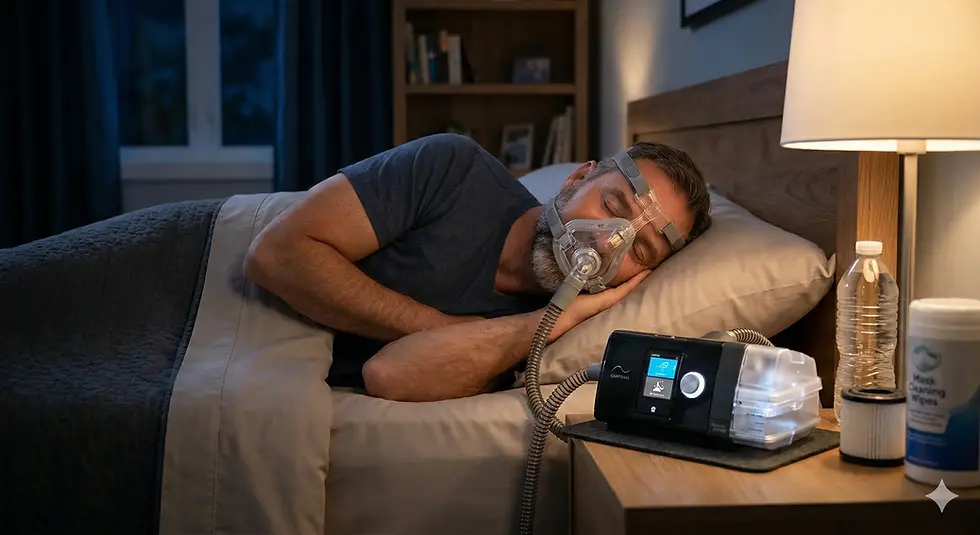
Here's the reframe that helps: your CPAP is not luggage. It's medication that happens to be shaped like a box. You wouldn't leave your BP tablets at home for a week. Same logic.
New to therapy and still adjusting? Read How Long Does It Take to Adjust to BiPAP or CPAP Therapy before your first trip — travelling is much easier once the mask feels normal.
Can I carry a CPAP machine in flight? (And does it count as my cabin bag?)
Yes — and no, it usually doesn't count against your baggage allowance.
A CPAP is classified as an assistive/medical device rather than ordinary luggage. IndiGo, for example, lists CPAP under assistive devices, which are not counted towards your carry-on or checked baggage limits, as long as they still meet standard size, weight and safety rules. On US-touching routes, disability regulations go further and formally protect your right to bring an assistive device in addition to your normal carry-on, provided the bag isn't stuffed with personal items too.
Three rules that matter more than anything else in this article:
Never, ever check your CPAP. Cargo holds are cold, unpressurised in parts, and rough. Machines get crushed, lost or delayed — and a delayed bag means a night without therapy. Carry it in the cabin, always.
Carry it in its own case, not buried inside your suitcase. If it's inside your trolley bag, it's part of your trolley bag. In a separate dedicated CPAP case, it reads instantly as a medical device.
Don't pack personal items in the CPAP bag. A machine bag that's also holding your shoes and snacks stops qualifying as a medical exemption.
Pro tip: Print the page from your device manual that shows it's a medical device, and keep it inside the case. Gate agents are human — a printout ends a five-minute argument in five seconds.
Airline rules in India (and what they actually ask for)
Indian carriers all allow CPAP machines. Where they differ is what happens if you want to switch it on mid-flight.
Airline | Carrying it on board | Using it in flight | What to arrange in advance |
IndiGo | Allowed — treated as an assistive device, outside baggage limits | Confirm with the airline before travel | Inform at booking; carry prescription |
Air India | Allowed — device should be FAA/EASA-approved | Permitted with a signed physician's statement of medical need; inform the flight commander and cabin crew | Medical clearance forms + documentation submitted ahead; batteries for 150% of flight time |
SpiceJet | Allowed, subject to security clearance | Permitted; battery capacity for 150% of flight time if used on board | Advance notification + prescription |
Most international carriers (US/EU) | Allowed, exempt from carry-on limits | Usually allowed with advance notice | Notify 48–72 hrs ahead; FAA-compliant battery |
Policies change. Always reconfirm on your airline's medical assistance page 3–4 days before departure — and take a screenshot of the policy page onto your phone.
Why "150% of flight time" keeps appearing: in-seat power is never guaranteed. Sockets fail, they're absent in many economy cabins, and several airlines don't approve them for medical devices at all. So airlines ask you to carry enough battery to cover the whole flight plus a 50% buffer for taxiing, holding patterns and diversions. A 4-hour Delhi–Bangkok flight means planning for 6 hours of battery.
Do I need a doctor's letter or prescription?
Not always required — but always worth carrying. It costs nothing and solves everything.
Document | Do you need it? | Why it's worth carrying |
CPAP prescription copy | Sometimes | Proves medical necessity at security, customs and to gate staff |
Doctor's letter of medical necessity (on letterhead, with your name, diagnosis and device model) | Required by some airlines for in-flight use | The single most useful piece of paper you can carry |
Sleep study report | Rarely | Essential if you need an emergency replacement or refill abroad |
Device manual page / FAA-EASA compliance statement | Required by Air India-style policies | Settles "is this approved?" instantly |
Purchase invoice | Rarely | Useful at customs if the machine looks brand new |
Customs tip: a visibly used machine almost never gets questioned. A device in sealed retail packaging can look like an import for sale. If yours is new, carry the invoice.
Not sure whether you should even be travelling with a CPAP or a BiPAP? Our guide on the difference between BiPAP and CPAP breaks it down in plain language.
Batteries and power: the section that trips people up
If you're going to be stopped anywhere, it'll be here — because CPAP batteries are lithium-ion, and lithium-ion is the one thing aviation security genuinely worries about.
The rules, in one table
Battery rating | Cabin baggage | Checked baggage | Conditions |
0–100 Wh | ✅ Allowed | ❌ Spares not allowed | No approval needed for personal use |
101–160 Wh | ✅ Allowed | ❌ Not allowed | Needs airline approval; maximum 2 spare batteries per passenger |
Above 160 Wh | ❌ Forbidden | ❌ Forbidden | Not permitted on passenger aircraft |
Two non-negotiables: spare batteries and power banks must travel in the cabin, never in checked bags, and terminals must be protected against short-circuiting (original box, or tape over the contacts).
How to work out your battery's Wh rating
Most batteries print it on the label. If yours doesn't:
Watt-hours (Wh) = Voltage (V) × Amp-hours (Ah)
So a 14.8 V, 6 Ah battery = 88.8 Wh → comfortably in the "no approval needed" band.
How long will a battery actually last?
Runtime depends far more on your settings than on your machine's brand:
Setting | Effect on battery life |
Heated humidifier ON | Cuts runtime dramatically — often by half or more |
Heated tube ON | Significant additional drain |
High pressure (e.g. 14+ cmH₂O) | Shorter runtime |
Mask leak | Machine works harder, drains faster |
Humidifier OFF + HME (waterless) filter | Longest runtime — the standard travel configuration |
The rule of thumb: for any flight or any night off-grid, run the machine dry with a heat-and-moisture exchanger instead of the water chamber. You'll trade a little comfort for double the runtime.
Can I use my CPAP during the flight?
Usually yes — with three conditions: advance notice, your own power, and a bit of seat strategy.
The four-step in-flight routine:
Notify the airline 48–72 hours ahead. Some carriers have a medical form; most just want it noted on the booking.
Pick a window seat. You get a wall to lean on, and you're not climbing over strangers at 2 a.m. with a hose on your face. (Aisle or bulkhead works if you need more room to set up.)
Switch off the humidifier and empty the water chamber before boarding. Water in a moving aircraft is a spill waiting to happen — and it kills your battery.
Tell the cabin crew before you switch it on. Every airline expects this, and it takes ten seconds.
Realistic expectation: you're not going to get eight hours of deep sleep in economy. But two or three protected hours on a long-haul is the difference between arriving functional and arriving wrecked.
Security screening and distilled water
At the security checkpoint
Take the machine out of its bag and put it in a separate tray, exactly like a laptop. You don't need to dismantle it — leaving the hose attached is fine. Expect the officer to swab it for explosive trace residue; that's routine and takes about half a minute.
Hygiene move most people miss: carry the machine inside a clear plastic bag, and keep a few alcohol wipes in the side pocket. Your machine has just been handled on a public conveyor belt. Wipe it down before it goes back in the case.
Distilled water: the honest rules
Situation | What's allowed |
Distilled water in cabin baggage | Standard liquid limit applies — up to 100 ml in most jurisdictions |
Medically necessary liquids above 100 ml | Generally permitted if declared at screening and supported by a prescription — declare it, never hide it |
Distilled water in checked baggage | Allowed in reasonable quantity — seal it in a zip bag; cabin pressure makes bottles leak |
After security | Airport pharmacies often stock it — the easiest option of all |
At your destination in India, distilled water is easy to find: chemists, medical stores and even battery/auto shops stock it. Ask for "distilled water" specifically — not mineral, not RO, not "pure."
If you genuinely can't find any: run the humidifier dry for a night, or switch to an HME filter. In an emergency, water boiled for 15–20 minutes and cooled will do less harm than tap water — but rinse the chamber daily and go back to distilled as soon as you can. Never use tap water. The minerals scale up your chamber, and if the local water isn't safe to drink, it isn't safe to breathe.
Travelling inside India: trains, road trips, hill stations and weddings
This is where most guides stop — and where Indian travellers actually need help.
Scenario | The problem | The fix |
Overnight train (AC coach) | Sockets exist but aren't guaranteed to be working, free or near your berth | Carry a charged battery pack; take a lower berth; keep the machine in your bag, not the overhead rack |
Self-drive road trip | No mains power at halts | A DC converter runs the machine off a 12 V car socket — charge the battery while you drive |
Homestays and hill stations | Power cuts, unreliable supply, sockets far from the bed | Carry a 3–5 m extension cord and a battery as backup. Check whether your model auto-adjusts for altitude — most modern ones do |
Wedding venues / farmhouses on generator power | Unstable voltage | Prefer a pure sine-wave inverter supply; if unsure, run off battery for the night |
Summer travel | Never leave the machine in a parked car — heat damages electronics and warps the humidifier chamber | Carry it in with you |
Monsoon / humid coastal travel | Condensation ("rainout") in the tube | Lower humidity settings, keep the tube under the blanket, or use a tube wrap |
Char Dham / pilgrimage travel | Long stretches with no reliable power | Battery + waterless HME setup is the only reliable configuration |
International travel: voltage, plugs and the one label to check
Most modern CPAP power supplies are dual-voltage (100–240 V) — which means you need a plug adapter, not a voltage converter.
Verify it yourself in ten seconds: read the small print on your power brick. If it says, you're fine anywhere in the world with just a physical adapter.
Destination | Plug type | Voltage |
India, Nepal, Sri Lanka | C / D / M | 230 V |
UK, Singapore, Malaysia, UAE (partly) | G | 230–240 V |
Europe (most) | C / F | 230 V |
USA, Canada, Japan | A / B | 100–120 V |
Australia, New Zealand | I | 230 V |
Book smart: when you book the hotel, message them and ask for a socket near the bed and a bedside table. Most hotels will happily move furniture — but only if you ask before you arrive at midnight.
Travel CPAP vs your home CPAP: do you actually need a second machine?
Be honest about how often you travel. If it's twice a year, your home machine in a padded bag is perfectly fine — it's already exempt from baggage limits. If you're on a flight every month, a travel unit changes the experience completely.
Home CPAP (e.g. ResMed AirSense 11) | Travel CPAP (e.g. ResMed AirMini, BMC M1 Mini) | |
Weight | ~1.2–1.5 kg with humidifier | Under 400 g for the BMC M1 Mini |
Humidification | Heated water chamber | Waterless (heat-and-moisture exchanger) |
Distilled water needed | Yes | No |
Battery friendliness | Moderate | Excellent |
Screen / controls | On-device screen | App-controlled via Bluetooth |
Best for | Daily home therapy | Frequent flyers, camping, hotel-heavy work travel |
Cabin exemption | Yes | Yes |
Machines worth looking at
BMC M1 Mini Travel Auto CPAP — one of the smallest CPAPs available at under 400 g, with auto pressure adjustment, app-based control, auto start/stop, auto ramp, mask-leak alerts, and optional waterless humidification via a moisture exchanger. It's compatible with standard CPAP masks, which means you can keep the mask you already trust.
ResMed AirMini Travel Auto CPAP — pocket-sized, but runs ResMed's proven AutoSet algorithm, so you're not compromising on therapy quality to save space.
ResMed AirSense 11 AutoSet — the flagship home machine, and still very travel-capable if you leave the water chamber dry.
ResMed AirStart 10 Auto CPAP — the value pick for reliable home-and-occasional-travel use.
Comparing across the whole range first? Start with our ResMed CPAP machine page, or read Philips DreamStation vs DreamStation 2 if you're already in the Philips ecosystem.
Can I rent a CPAP machine for a trip?
Yes — and for a lot of people it's the smarter move.
Renting makes sense if you're travelling for a few weeks and don't want to risk your primary machine in transit, if a family member is visiting and needs therapy while they're staying with you, if you're recovering post-surgery and need short-term support, or if you want to try a travel unit before committing to buying one.
At Healthy Jeena Sikho we've supplied respiratory equipment to over one lakh Indian families since 2015, with stores across Delhi, Noida, Gurgaon, Chandigarh, Mohali, Ludhiana, Jalandhar, Lucknow and Jaipur — and same-day delivery on ready stock. We're an authorised ResMed distributor, and ISO and MSME certified.
📞 Call +91 98769 78488 to check availability before your travel dates.
Haven't been diagnosed yet — but you snore, wake up tired, or your partner has noticed you stop breathing? Get it checked before you plan a big trip. Our sleep study test at home starts at ₹1,999, uses ResMed diagnostic equipment, needs no hospital stay, and gets you a pulmonologist-reviewed report within 24 hours. You can also read about the Level-2 polysomnography option if your case is more complex.
Hygiene on the road (the part everyone skips)
Hotel rooms are not your bedroom. Dust, air-conditioning and unfamiliar bedding all end up in your mask.
The five-minute daily travel routine:
Wipe the mask cushion every morning with a CPAP wipe or a soft cloth
Empty and dry the water chamber every single day — never leave standing water in it
Air-dry the tube by hanging it over a chair or towel rail
Give the machine surface a wipe after security handling
Wash the mask and tube properly in mild soapy water once a week and dry them fully away from direct sunlight
Pack a spare mask cushion. It weighs almost nothing and saves an entire trip if the old one tears or the seal goes. If your mask has never quite felt right, our CPAP mask types and fitting guide is worth ten minutes before you fly.
The complete CPAP travel checklist
Print this. Tick it the night before.
Sr No | Item | Cabin or checked? | Notes |
1 | CPAP machine in padded case | Cabin only | Never check it |
2 | Mask + headgear | Cabin | Pack a spare cushion |
3 | Tubing | Cabin | Consider a short travel tube |
4 | Power cord + brick | Cabin | Check it's rated 100–240 V |
5 | Universal plug adapter | Cabin | Match the destination plug type |
6 | Battery pack (charged) | Cabin only | Know the Wh rating |
7 | DC/car adapter | Either | Essential for road trips |
8 | HME / waterless humidifier filters | Cabin | The single best travel accessory |
9 | Distilled water (small bottle) | 100 ml cabin / larger checked | Or buy after security |
10 | Spare filters | Cabin | Weightless, easily forgotten |
11 | Prescription + doctor's letter | Cabin | Digital copy on your phone too |
12 | CPAP wipes | Cabin | For post-screening cleaning |
13 | Extension cord (3–5 m) | Checked | Hotel sockets are never near the bed |
14 | Zip-lock bags | Either | Contain leaks, keep the mask clean |
Seven mistakes that ruin CPAP trips
Mistake | What goes wrong | The fix |
Checking the machine in | Damaged, delayed or lost — no therapy on night one | Cabin, always |
Leaving water in the chamber | Spills into the machine mid-journey | Empty and dry before you leave |
Assuming there's a plug on the plane | No power, no therapy | Carry a charged battery |
Spare battery in the checked bag | Confiscated at screening | Spares travel in the cabin only |
Packing the CPAP inside the trolley bag | Loses its medical-device exemption | Separate dedicated case |
Using tap water abroad | Mineral scaling, possible infection risk | Distilled water or run dry |
Skipping therapy "just for the holiday" | Headaches, fatigue, snoring, drowsy driving | Treat it like medication |
Frequently asked questions
Q. Does a CPAP machine count as a carry-on bag?
CPAP machines are generally carried in the cabin in their dedicated protective case. However, baggage policies vary by airline, so check with your airline before travelling. Keep the CPAP machine and its accessories together and avoid placing personal items in the medical-device case if your airline treats it separately.
Q. Can I carry a CPAP machine on a domestic flight in India?
Yes, CPAP machines can generally be carried when travelling by air in India. Before your journey, check the latest baggage and medical-device requirements of your airline. If you plan to use the CPAP machine during the flight, contact the airline in advance to confirm its requirements.
Q. Do I need airline permission to use my CPAP in flight?
For carrying it, no. For using it in the air, yes — notify the airline 48–72 hours ahead and inform the cabin crew before switching it on.
Q. Can I put my CPAP machine in checked baggage?
You can, but you shouldn't. Cargo holds damage devices and bags get delayed. Spare lithium batteries are not permitted in checked baggage at all.
Q. What's the battery limit for a CPAP on a plane?
Lithium batteries up to 100 Wh are allowed without approval. Between 101 and 160 Wh you need airline approval and can carry a maximum of two spares. Anything above 160 Wh is prohibited on passenger aircraft.
Q. How do I calculate my battery's watt-hours?
Multiply voltage by amp-hours. A 14.8 V, 6 Ah battery is 88.8 Wh.
Q. Can I take distilled water through airport security?
Up to the standard 100 ml liquid limit in cabin baggage. Larger quantities go in checked baggage, or declare it at screening as a medically necessary liquid with your prescription. The simplest option is to buy it after security or at your destination.
Q. Can I use my CPAP without distilled water?
Yes, for short periods. Run the humidifier dry or use a heat-and-moisture exchanger. Expect a drier nose and throat. Never substitute tap water.
Q. Do I need a voltage converter for international travel?
Usually not. Most CPAP power supplies are dual-voltage (100–240 V), so a plug adapter is enough. Check the label on your power brick to confirm.
Q. Will altitude affect my CPAP therapy?
Most modern CPAP machines compensate for altitude automatically within a set range. Check your model's manual before travelling to high-altitude destinations, and tell your doctor if you're going considerably higher than usual.
Q. Can I take a CPAP machine on an Indian train?
Yes. AC coaches typically have charging points, but availability and reliability vary — carry a charged battery pack, and keep the machine with you rather than in the overhead rack.
Q. Can I rent a CPAP machine instead of travelling with mine?
Yes. Healthy Jeena Sikho offers CPAP and BiPAP machines on rent across 15+ cities in North India with same-day delivery on ready stock. Call +91 98769 78488.
Q. What if my CPAP stops working while I'm travelling?
Check the power source, the filter and the mask seal first — most in-trip failures are one of those three. Our guide on what to do if your CPAP stops delivering air properly walks through the fixes.
The bottom line
Travelling with a CPAP machine sounds complicated exactly once — the first time. After that it's a routine: machine in the cabin, battery charged, humidifier dry, prescription on your phone, plug adapter in the side pocket.
Sleep apnea already takes enough from you. Don't let it take your holiday too.
Need a travel CPAP, a rental, or a sleep study before you fly?
📞 Call +91 98769 78488
💬 WhatsApp +91 98759 15278
Medical disclaimer: This article is for education and awareness only and is not a substitute for medical advice. CPAP and BiPAP machines are prescription medical devices. Do not change your pressure settings, switch devices or stop therapy without consulting your treating doctor.


According to kansas city software development companies I had the pleasure of working with and the experience was truly exceptional. Their team was not only knowledgeable but also incredibly responsive, making the entire process smooth and enjoyable. I was impressed by their ability to understand my vision and translate it into a functional product that exceeded my expectations. I feel hopeful about the future of my project, knowing I have such a talented team behind me. Highly recommend to anyone looking for innovative solutions!
For any creative team business looking to hire top talent fast Mantner like a smart helper that quickly matches companies with the right people for their needs!
I started reading this without any particular expectations, but it ended up answering several questions that had been on my mind. The way the subject was explained made it much easier to understand. I decided to continue looking into the matter and spent some time researching DigitalSuits migrating from Wix to Shopify services as well.
This guide is incredibly helpful for anyone struggling with the logistics of traveling with a medical device. It really puts things into perspective by framing the machine as essential medication rather than just another piece of luggage. I have been exploring creative ways to document my travel experiences lately, and I have been testing out the wan 3.0 ai video generator to turn my trip footage into better quality
Excellent contenu avec une présentation naturelle et des informations vraiment accessibles. Il est toujours intéressant de découvrir une méthode simple pour pratiquer la vitesse de clic sans perdre de temps. Vous pouvez essayer ce test de click. Cet outil fournit des résultats rapides et facilite la comparaison entre différentes tentatives. Cela peut rendre les séances d’entraînement plus intéressantes, surtout lorsqu’on souhaite observer ses progrès progressivement. Une approche simple comme celle-ci permet de pratiquer régulièrement tout en gardant une bonne motivation.