
Best Sleeping Position While Using BiPAP Machine — Complete Guide

Updated: Jul 7

Sleeping comfortably with a BiPAP machine can be difficult for many first-time users. Mask leaks, discomfort, and interrupted sleep are common problems. Choosing the right sleeping position can make your therapy much more effective and comfortable.
What Is a BiPAP Machine and Why Does Sleep Position Matter?
BiPAP stands for Bilevel Positive Airway Pressure. It delivers two levels of air pressure — a higher pressure when you breathe in and a lower pressure when you breathe out. This makes breathing easier for people with conditions like COPD, Sleep Apnea, Obesity Hypoventilation Syndrome, and respiratory muscle weakness.
Unlike regular sleep, sleeping with a BiPAP machine involves a mask strapped to your face, a tube connected to a machine, and a constant flow of pressurized air. This means your sleeping position directly affects how well the therapy works.
The wrong position can cause mask leaks, pressure loss, skin discomfort, aerophagia (air swallowing), and interrupted therapy — all of which reduce the benefit of the machine and disturb your sleep quality.
Which BiPAP Mask Type Are You Using?
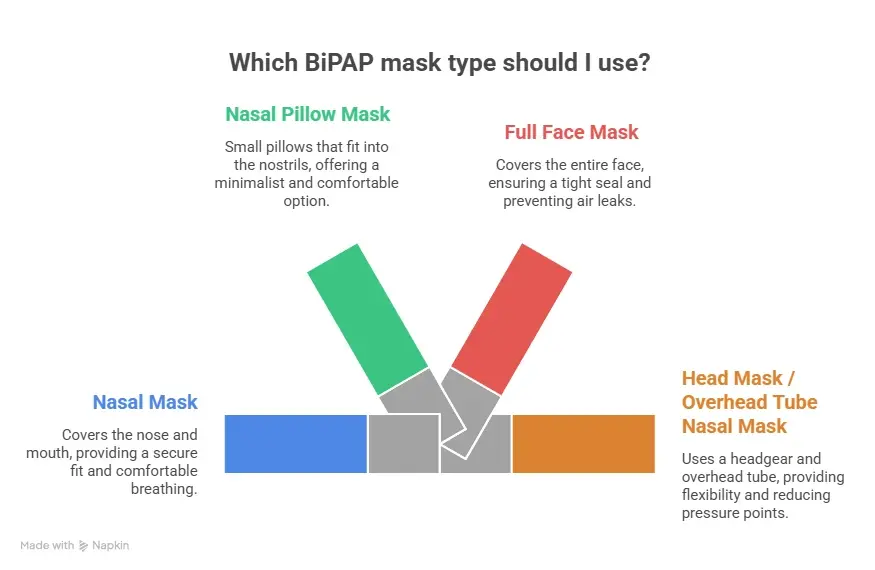
Before we talk about sleeping positions, it is important to understand your mask type — because the best position for you also depends on which mask you are wearing. There are four main types of BiPAP masks and each one works differently with different sleeping positions.
Nasal Mask
A nasal mask covers only your nose — not your mouth. It is one of the most popular BiPAP mask types in India. It is smaller, lighter, and feels less claustrophobic than a full face mask. The nasal mask works best for side sleeping because it has a lower profile and is less likely to get pushed out of position when your face is against a pillow. However, if you tend to breathe through your mouth during sleep, a nasal mask will not be effective as all the pressurized air will escape through your open mouth.
Best sleeping position with nasal mask: Side sleeping or slightly elevated back sleeping.
Nasal Pillow Mask
A nasal pillow mask is the smallest and most minimalistic BiPAP mask available. Instead of covering the nose, it has two small soft cushions — called pillows — that sit just at the entrance of the nostrils and deliver air directly. This mask is extremely comfortable for side sleepers because there is almost nothing on the face to get shifted or pressed by a pillow. It is also ideal for people who feel claustrophobic with larger masks or who wear glasses and read before bed. The nasal pillow mask is highly recommended for active sleepers who move around a lot at night.
Best sleeping position with nasal pillow mask: Side sleeping on either side — this mask handles position changes the best of all mask types.
Full Face Mask
A full face mask covers both the nose and mouth. It is the most commonly prescribed mask for patients who breathe through their mouth during sleep, or who have higher pressure settings. The full face mask is bulkier and has a larger surface area, which means it is more prone to leaks when you sleep on your side and the pillow presses against the mask frame. For full face mask users, back sleeping with the head elevated is often more comfortable. If you prefer side sleeping with a full face mask, a BiPAP-specific pillow with a cutout is essential.
Best sleeping position with full face mask: Elevated back sleeping at 30 to 45 degrees, or side sleeping with a BiPAP pillow.
Head Mask / Overhead Tube Nasal Mask
A head mask style nasal mask is a special type where the mask sits only on the nose — covering just the nostrils — but unlike a regular nasal mask, the air tube does not come out from the front of the face. Instead the tube runs up and over the top of the head, connecting to the BiPAP machine from behind. This overhead tube design is a game changer for side sleepers because there is no tube at the front of the face to get tangled, pulled, or pressed against the pillow during the night.
This mask type is ideal for people who move around frequently during sleep, couples sharing a bed where a front tube feels intrusive, and patients who want the freedom to turn from side to side without worrying about their tube getting caught. The ResMed AirFit P30i and Fisher and Paykel Brevida are popular examples of this top-of-head tube nasal mask style.
Best sleeping position with head tube nasal mask: Side sleeping on either side — this is actually one of the best masks specifically designed for active side sleepers.
Many first-time BiPAP users in India complain that their mask starts leaking when turning sideways during sleep. In our experience, switching from a bulky full-face mask to a nasal pillow mask often improves comfort dramatically within a few nights.
Best Sleeping Position While Using BiPAP Machine at Home — Position by Position Breakdown
Now that you know your mask type, here is the complete guide to every sleeping position and how it works with BiPAP therapy.
Side Sleeping (Left or Right) — The #1 Recommended Position
Side sleeping is universally considered the best sleeping position while using a BiPAP machine at home for most patients. Here is why it works so well:
Side sleeping naturally keeps your airway open by preventing the tongue and soft palate from falling backward into the throat. This means the BiPAP machine does not have to work as hard to maintain your airway, resulting in more stable pressure delivery and fewer apnea events.
Sleep specialists and organizations such as the American Academy of Sleep Medicine also recognize positional sleeping strategies as helpful for many obstructive sleep apnea patients.
For most patients — especially those with Sleep Apnea or COPD — side sleeping dramatically reduces the number of breathing interruptions during the night compared to back sleeping.
Left Side vs Right Side — Which Is Better?
Both sides work well, but the left side has some additional advantages. Sleeping on the left side improves circulation, reduces acid reflux which is common in COPD and obese patients, and takes pressure off the heart. If you have heart failure or GERD alongside your breathing condition, left side sleeping is particularly beneficial.
Best mask for side sleeping: Nasal pillow mask or nasal mask. These have the lowest profile and handle side sleeping the most comfortably. If using a full face mask on your side, use a BiPAP pillow with a mask cutout.
Tips for comfortable side sleeping with BiPAP:
Use a BiPAP-friendly pillow with a cutout or contour design that accommodates the mask without pressing against it and causing leaks. Place a pillow between your knees to align your hips and reduce back strain. Make sure the BiPAP tube runs toward the back of your head or overhead to avoid pulling or kinking during the night. Check your mask seal before sleep — side sleeping can sometimes shift masks, so ensure the fit is firm.
Sleeping on Your Back — When It Works and When to Avoid It
Sleeping on your back is the second most common position for BiPAP users. For patients whose primary issue is not Obstructive Sleep Apnea — for example those using BiPAP for COPD or neuromuscular conditions — back sleeping with the head slightly elevated works well.
However, for patients with Obstructive Sleep Apnea, back sleeping is generally problematic because gravity pulls the tongue and soft tissue toward the back of the throat, increasing airway obstruction. Even with BiPAP running, back sleeping can reduce therapy effectiveness in OSA patients.
The Exception — Elevated Back Sleeping
If you must sleep on your back, elevating the head of your bed by 30 to 45 degrees significantly improves comfort and therapy effectiveness. An elevated position reduces the work of breathing, decreases acid reflux, and keeps the airway more open.
Best mask for back sleeping: Full face mask or head mask. Back sleeping with an open mouth is common, so a mask covering both nose and mouth gives better therapy.
Comparison table:
Sleeping Position | Best For | Avoid If | Best Mask |
Side Sleeping | OSA, COPD | Shoulder pain | Nasal Pillow |
Back Sleeping | COPD | Severe OSA | Full Face |
Stomach Sleeping | None | Everyone | None |
Our adjustable hospital beds and motorised recliner beds are extremely popular among BiPAP users — they allow you to set the perfect head elevation without needing to stack multiple pillows that keep falling during the night.
Tips for back sleeping with BiPAP:
Elevate the head by at least 30 degrees using an adjustable bed or wedge pillow. Use a full face mask rather than a nasal mask as back sleeping with mouth breathing is more common. Avoid sleeping completely flat — this is the most problematic position for almost all BiPAP users.
Sleeping on Your Stomach — Avoid This Completely
Stomach sleeping is the worst position for BiPAP users and should be avoided regardless of which mask type you use. When you sleep on your stomach, your face is pressed into the pillow making it almost impossible to maintain a proper mask seal. Every mask type — nasal pillow, nasal, full face, or head mask — will leak constantly in this position.
Additionally, stomach sleeping twists your neck, puts pressure on your spine, and makes it difficult for the BiPAP machine to deliver consistent pressure.
If you are a natural stomach sleeper, place a full-length body pillow along your side. This creates a barrier that naturally prevents you from rolling onto your stomach during the night.
Semi-Reclined Position — Excellent for COPD and Heart Patients
For patients with severe COPD, heart failure, or those recovering from respiratory illness, a semi-reclined position at 30 to 45 degrees is often the best sleeping position while using BiPAP machine at home.
This position is also called the Fowler position in medical terminology. It significantly reduces the effort needed to breathe, keeps fluid from accumulating in the lungs, and allows the diaphragm to move more freely.
Best mask for semi-reclined sleeping: All mask types work reasonably well in this position. The full face mask and head mask are particularly stable in a reclined position as the larger surface area stays more evenly sealed.
A motorised recliner bed or adjustable ICU-style hospital bed makes maintaining this position effortless throughout the night. The patient does not have to struggle with pillows falling out of place — the bed holds the exact angle all night long.
How to Reduce Mask Leaks in Every Sleeping Position
Mask leaks are the number one complaint of BiPAP users and are heavily influenced by sleeping position. Here is how to minimize them regardless of how you sleep:
Always fit your mask while lying in your actual sleeping position, not while sitting up. The face changes shape slightly when horizontal. If you sleep on your side, use a BiPAP-specific pillow with a mask cutout — this works especially well with nasal and full face masks. Tighten the mask straps one click tighter than usual before bed if you know you move around at night. Check the mask cushion regularly — worn-out cushions are a major cause of leaks in all mask types. If your nasal pillow mask leaks, try adjusting the pillow size — they come in small, medium, and large fittings.
How Healthy Jeena Sikho Supports BiPAP Patients at Home
We have been supporting over 1 lakh Indian families since 2015 with home respiratory care. We are an authorized dealer for ResMed and Philips — the most trusted BiPAP brands in India — and stock all mask types including nasal pillow masks, nasal masks, full face masks, and head masks.
We offer BiPAP machines on rent and sale with same-day delivery across Delhi NCR, Chandigarh, Mohali, Ludhiana, Jalandhar, Lucknow, Jaipur, and more. Our team helps you with mask selection, machine setup, and ongoing support so you are never alone in your BiPAP journey.
Call us: +91 9876978488
Visit: www.healthyjeenasikho.com
Frequently Asked Questions (FAQs)
Q1. What is the best sleeping position while using a BiPAP machine at home?
Side sleeping — particularly the left side — is the best position for most BiPAP users. It keeps the airway naturally open, reduces mask leaks, and improves therapy effectiveness. For COPD and heart patients, a semi-reclined position at 30 to 45 degrees is also excellent.
Q2. Which BiPAP mask is best for side sleeping?
The nasal pillow mask is the best mask for side sleeping because of its minimal size and low profile. It sits at the entrance of the nostrils and does not get pressed or displaced by a pillow. A nasal mask is also good for side sleeping. If you use a full face mask, pair it with a BiPAP-specific pillow that has a mask cutout.
Q3. Can I sleep on my back with a BiPAP machine?
Yes, but elevate your head by at least 30 degrees. For Sleep Apnea patients, flat back sleeping increases airway obstruction and reduces therapy effectiveness. For COPD or heart patients, slightly elevated back sleeping or semi-reclined sleeping is often very comfortable.
Q4. Why does my BiPAP mask leak when I sleep on my side?
Side sleeping can shift the mask and break the seal, especially with full face masks. Use a BiPAP-specific pillow with a cutout for the mask. Also ensure the mask is fitted while you are in your sleeping position. Switching to a nasal pillow mask often completely solves leak problems for side sleepers.
Q5. Is it safe to use BiPAP while sleeping on my stomach?
No. Stomach sleeping is not safe or effective with any type of BiPAP mask. It causes constant mask leaks and eliminates therapy benefit. Use a body pillow along your side to break the stomach sleeping habit over time.
Q6. What type of bed is best for BiPAP users?
An adjustable hospital bed or motorised recliner bed is ideal for BiPAP users as it allows you to set the exact head elevation needed for comfortable therapy. Healthy Jeena Sikho offers a full range of adjustable beds on rent and sale with same-day delivery across North India.
Q7. I use a full face mask and cannot sleep on my side comfortably — what should I do?
Try a BiPAP pillow which has cutouts specifically designed for full face mask users. Alternatively, ask your doctor or respiratory therapist if you can switch to a nasal mask or nasal pillow mask — many patients find side sleeping becomes much easier with the smaller mask types.
Q8. Where can I buy BiPAP masks and machines in India with home delivery?
Healthy Jeena Sikho offers all types of BiPAP masks and machines including ResMed Airfit F20 full face mask and ResMed N20 nasal mask on sale with same-day delivery across 15 cities. Call +91 9876978488 or visit www.healthyjeenasikho.com.
Final Thoughts — Right Mask Plus Right Position Equals Great Sleep
BiPAP therapy is only as effective as the sleep you get while using it. Choosing the best sleeping position while using a BiPAP machine at home — matched with the right mask type for that position — can completely transform your experience from frustrating to genuinely restful.
Start with side sleeping and a nasal pillow mask if possible. Elevate your head if you prefer back sleeping and use a full face mask. Avoid stomach sleeping with any mask. And give yourself 3 to 4 weeks to fully adapt.
If you need help choosing the right mask, setting up your BiPAP, or finding the perfect adjustable bed for comfortable therapy, our team at Healthy Jeena Sikho is just one call away.
Call us: +91 9876978488
Same-day delivery across 15 cities in North India


I tend to read the rules before trying any new game, particularly when there is money involved. While looking into okwin game, that would be my main approach as well. Understanding the game mechanics, entry conditions, and withdrawal rules can prevent misunderstandings later. Anyone considering such a platform should also check local regulations and avoid spending more than they can comfortably afford.
I've started noticing that my focus tolerates repetition much better aport https://melbets-app.com/ when I understand why the repetition matters, even if the task itself hasn't changed at all. The same motion that feels tedious in isolation becomes almost meditative once I connect it to a reason. That shift is entirely internal — nothing about the task changes — which made me curious about how much of "boring" is really just unexplained.
Custom decks can add significant character to residential properties by introducing unique architectural elements. Homeowners can select shapes, colors, and finishes that match their existing exterior design. Curved layouts, multi-level structures, and decorative details create distinctive outdoor environments. These personalized touches make each deck different from standard installations. A carefully crafted custom deck becomes Deck Repair Colorado an extension of the home rather than just an additional outdoor structure.
You guide a small alien through space in run 3, a game where you can keep running. You play as a little gray alien in this fun action/platform game. It's like having a never-ending running game.