
Anti-Bedsore Air Mattress vs Foam Mattress: Which One Should You Add to Your Hospital Bed?


Quick Answer
If your patient has been bedridden for more than 48 hours, a foam mattress alone is not enough. For early-stage risk (no wounds yet, patient can be repositioned every 2 hours), a high-density medical foam mattress may suffice. For any patient already showing skin redness, existing pressure ulcers (Stage 2 and above), or those who cannot be regularly turned, an anti-bedsore tubular air mattress is the medically recommended standard — and the one Healthy Jeena Sikho stocks and delivers same-day across India.
Why This Decision Is More Urgent Than Most Families Realise
Bedsores — clinically called pressure ulcers or decubitus ulcers — are one of the most preventable yet most common complications in bedridden patients cared for at home.
Every Indian caregiver needs to know these facts before choosing a mattress:
A Stage 1 pressure ulcer (skin redness) can develop within 2–4 hours of continuous pressure on a single body point
Once a wound reaches Stage 3 or 4 (deep tissue damage, exposed bone), recovery can take months to years and may require surgery
Most home-care patients in India develop bedsores within the first two weeks of discharge — often because families underestimate mattress selection
Treating an advanced pressure ulcer costs ₹20,000 to ₹2,00,000+ — versus ₹9,000 for the right mattress on day one
The right mattress, chosen before a wound develops, prevents all of this.
Understanding Pressure Ulcers: The 6-Stage System
Before comparing mattresses, it is important to understand exactly what you are trying to prevent.
Stage | What You See | What It Means | Urgency |
Stage 1 | Persistent redness (doesn't turn white when pressed) | Skin intact — early warning | Act within 24 hours |
Stage 2 | Shallow open wound or blister | Partial skin loss | Switch to air mattress immediately |
Stage 3 | Deep open wound, visible fat tissue | Full skin loss, infection risk | Medical consultation required |
Stage 4 | Bone, tendon, or muscle exposed | Severe tissue damage | Hospital consultation urgently |
Unstageable | Wound covered by dead tissue (eschar) | Cannot assess depth | Wound care nurse needed |
Deep Tissue Injury | Deep purple or maroon patch under intact skin | Underlying damage before surface breaks | Air mattress + urgent review |
The most important insight: By the time a wound is visible on the surface, significant damage has already occurred in the tissue underneath. Prevention must begin before Stage 1 appears.
What Is a Medical Foam Mattress?
A medical foam mattress is a dense, high-resilience polyurethane foam mattress engineered specifically for hospital beds. Unlike a regular home mattress, it has a firmer core for patient positioning and a clinical-grade fabric cover that can be wiped down with disinfectants.
Types of Medical Foam Mattresses
Standard HD Foam: Density 30–35 kg/m³. Suitable for mobile patients or short-term (under 5 days) bed rest only.
High-Density Orthopaedic Foam: Density 40–45 kg/m³. Better pressure distribution, suitable for 1–4 week post-surgical recovery where the patient can be repositioned frequently.
Egg Crate (Convoluted) Foam: Top layer has a convoluted surface that modestly reduces contact points. A budget add-on — not a substitute for an air mattress in high-risk patients.
Memory Foam: Conforms to body shape, distributing weight more evenly. Better than standard foam, but still cannot replace an air mattress for patients with existing wounds or limited mobility.

Where Foam Mattresses Fall Short
Cannot actively redistribute pressure — entirely dependent on a caregiver repositioning the patient every 2 hours, including through the night
Heat retention — foam traps body heat, increasing perspiration and moisture at bony prominences, which directly accelerates skin breakdown — a significant problem in India's climate
No therapeutic benefit for patients with Stage 2 or higher wounds
Caregivers who miss even a few repositioning cycles significantly increase wound risk
What Is an Anti-Bedsore Tubular Air Mattress?
An anti-bedsore tubular air mattress — also called an alternating pressure mattress (APM) — is a powered medical device that actively prevents and manages pressure ulcers through automated pressure cycling.
It consists of a series of large air tubes (tubular cells) laid across the mattress surface, connected to an electric pump. The pump alternates which tubes are inflated and deflated on a timed cycle (typically every 5–10 minutes). This means no single point of the body remains under continuous pressure for more than a few minutes — even if the patient is never manually repositioned.
How the Tubular Alternating Pressure System Works
Cycle A (0–5 min): Odd tubes inflated
Cycle B (5–10 min): Even tubes inflated
Every 5–10 minutes, body weight shifts to a different set of tubes, giving previously compressed tissue time to recover blood flow and oxygen — replicating what natural movement does in a healthy, mobile person.
The tubular design is clinically superior to the older bubble/cell design because:
Larger tube diameter means greater surface area per pressure cycle
Tubes conform more closely to body contours (spine, sacrum, heels)
The undulating airflow provides a gentle therapeutic effect on soft tissue
Sturdier construction resists leakage over long-term use
Healthy Jeena Sikho's Tubular Anti-Bedsore Mattress Range
Healthy Jeena Sikho stocks three tubular air mattress options, all priced at ₹9,000 (regular price ₹15,500) with same-day delivery across Delhi, Noida, Gurgaon, Chandigarh, Ludhiana, Jalandhar, Lucknow, and Jaipur.
1. Olex Anti-Decubitus Cell Tubular Mattress
Best for: Moderate-risk patients, long-term bedridden care, patients who cannot be repositioned every 2 hours
The Olex Anti-Decubitus Cell Tubular Mattress is an alternating pressure system built on the tubular cell design. Olex is a trusted brand in clinical anti-decubitus therapy, widely used in Indian hospitals and home care settings.
Key features:
Alternating pressure system — automatic cycling every 5–8 minutes
Tubular cell structure for superior body contouring
Adjustable pressure settings by patient weight
Waterproof, antimicrobial cover — easy to wipe clean
Silent pump — minimal sleep disruption
Fits standard hospital bed frames (200 cm × 90 cm)
Comes with securing straps to prevent displacement
2. Premium Anti-Bedsore Air Mattress Tubular (Olex Brand)
Best for: High-risk patients, existing Stage 1–2 wounds, patients on home ventilators or BiPAP
The Premium Anti-Bedsore Air Mattress Tubular by Olex is the most advanced option in the Healthy Jeena Sikho range. It features a quiet pump, adjustable cycle pressure, and a vapour-permeable waterproof cover designed for prolonged clinical use.
Key features:
Advanced pressure redistribution — inflates and deflates tubes to eliminate sustained pressure on any area
Whisper-quiet pump — designed to not disturb sleep or BiPAP therapy
Safe and non-toxic materials — CE-compliant for home and clinical use
Adjustable firmness — pump settings match different patient weights
Gentle undulating airflow provides a therapeutic massage effect on soft tissue
Waterproof and antimicrobial surface — prevents infection at wound sites
Low power consumption — economical for 24/7 continuous use
Easy installation — fits most hospital bed frames, securing straps included
Ideal for: Patients with limited mobility, post-operative recovery, elderly care, home ICU setups, and nursing home use.
3. Premium Tubular Alpha Bed Mattress
Best for: Patients needing both comfort support and pressure relief; long-term home care with active caregiver
The Premium Tubular Alpha Bed Mattress combines the tubular alternating pressure mechanism with enhanced structural support. It is designed for patients requiring both pressure ulcer prevention and orthopaedic spinal alignment — common in stroke recovery, Parkinson's disease, and post-spinal surgery home care.
Key features:
Tubular design with consistent support across the entire mattress surface
Maintains proper spinal alignment while redistributing pressure
High-quality materials rated for long-term durability
Removable and washable cover — clinical hygiene maintenance
Plush, comfortable surface — accommodates multiple sleeping positions
Enhanced durability — resists wear and tear over extended use
Healthy Jeena Sikho Tubular Mattress Range at a Glance
Product | Brand | Best For | Price |
Olex Anti-Decubitus Cell Tubular Mattress | Olex | Moderate-to-high risk, long-term care |
|
Premium Anti-Bedsore Air Mattress Tubular | Olex | High-risk, existing wounds, ICU step-down |
|
Premium Tubular Alpha Bed Mattress | — | Long-term comfort + pressure relief, orthopaedic support |
|
All three products include:
Same-day delivery across all HJS service cities
Free installation and setup guidance
24/7 WhatsApp and phone support from our clinical team
CGHS/ECHS documentation support on request
Full Comparison: Foam Mattress vs Tubular Air Mattress
Feature | Medical Foam Mattress | Tubular Anti-Bedsore Air Mattress |
Pressure Relief Mechanism | Passive — body weight is static | Active — automated tube cycling every 5–10 min |
Requires Electricity | No | Yes (standard 5A socket) |
Repositioning Required | Every 2 hours — mandatory | Every 4–6 hours — greatly reduced |
Suitable for Stage 1 Risk | Yes, with strict repositioning | Yes |
Suitable for Stage 2 Wounds | No | Yes |
Suitable for Stage 3–4 Wounds | No | Yes (with wound care protocol) |
Noise Level | Silent | Quiet hum from pump (~40–48 dB) |
Heat and Moisture Control | Poor — foam retains heat | Good — airflow reduces skin temperature |
Therapeutic Benefit | None | Gentle massage via undulating airflow |
Infection Control | Wipe-clean cover | Waterproof, antimicrobial surface |
Caregiver Dependence | Very high | Low — machine compensates for missed turns |
Spinal Alignment | Moderate (HD foam) | Excellent (Tubular Alpha) |
Indian Summer Suitability | Poor — heat accelerates skin breakdown | Good — airflow keeps skin cooler |
Price at HJS | ₹3,000–₹6,000 | ₹9,000 (was ₹15,500) |
Best For | Short recovery, mobile patients | Bedridden patients, existing wounds, solo caregivers |
6 Questions to Decide Which Mattress Your Patient Needs Right Now
Work through these in order. Stop at the first "Yes."
1. Does your patient already have redness, blistering, or any open skin on bony areas?
Yes → You need a tubular anti-bedsore air mattress immediately. A foam mattress will worsen any existing wound without exception.
2. Will your patient be completely bedridden for more than 7 days?
Yes → Choose a tubular air mattress. Even the best foam mattress depends on a caregiver repositioning the patient every 2 hours — day and night, including 2 AM and 4 AM. Most home care settings cannot sustain this schedule. The air mattress compensates for missed turns.
3. Is there only one caregiver, or is the caregiver elderly, working during the day, or unwell themselves?
Yes → Choose a tubular air mattress. Solo or fatigued caregivers cannot maintain the repositioning schedule foam mattresses demand. The risk of bedsore development is very high without adequate turning.
4. Does your patient have diabetes, peripheral vascular disease, or low body weight (BMI under 18)?
Yes → Choose a tubular air mattress. These conditions severely impair blood flow and skin healing. Even brief periods of unrelieved pressure cause faster damage than in otherwise healthy individuals.
5. Is your patient on home ventilation, BiPAP, or cannot be repositioned due to surgical, cardiac, or spinal restrictions?
Yes → Choose the Premium Anti-Bedsore Air Mattress Tubular. Some post-surgical patients cannot be turned at all for defined periods. The tubular air mattress is the only safe option for these patients.
6. Is your patient recovering from a short procedure (knee replacement, appendix surgery etc.) and can sit up, shift weight, and leave the bed 2–3 times a day?
Yes → A medical foam mattress is sufficient, provided repositioning is done strictly as instructed.
Pressure Ulcer Risk Assessment: Braden Scale Guide
Most hospitals assess pressure ulcer risk using the Braden Scale before discharge. Scores range from 6 to 23 — lower scores mean higher risk.
Braden Score | Risk Level | Recommended Mattress |
19–23 | No risk | Standard HD foam mattress |
15–18 | Mild risk | HD orthopaedic foam + strict 2-hourly turning |
13–14 | Moderate risk | Tubular alternating pressure air mattress |
10–12 | High risk | Tubular alternating pressure air mattress (full replacement) |
9 or below | Very high risk | Premium Anti-Bedsore Tubular + clinical wound care review |
Ask your discharge nurse for your patient's Braden Score before leaving the hospital. If they did not give you one, call our clinical team — we can walk you through a rapid home risk assessment free of charge.
Condition-by-Condition Mattress Recommendation
Patient Condition | Recommended Mattress | Reason |
Post-knee or hip replacement (mobile within 24 hrs) | HD Foam Mattress | Short-term; patient can shift weight independently |
Post-stroke with hemiplegia | Tubular Air Mattress | Cannot reposition independently; high sacral risk |
Spinal cord injury / paraplegia | Tubular Air Mattress | Zero independent movement; high Stage 3–4 risk |
Dementia (restless, unpredictable) | Tubular Air Mattress | Cannot comply with turning instructions |
Cancer palliative care | Premium Anti-Bedsore Tubular | Fragile skin, cachexia, prolonged bed rest |
COPD with BiPAP (head elevated 30°+) | Tubular Air Mattress | Sacral pressure concentrated at 30° head elevation |
Post-abdominal surgery (limited turning) | Tubular Air Mattress | Surgical restrictions prevent adequate repositioning |
Diabetic foot / peripheral vascular disease | Tubular Air Mattress | Severe blood flow impairment — even brief pressure causes damage |
Elderly (75+) with low mobility | Tubular Alpha Bed Mattress | Fragile skin, poor tissue perfusion, long-term comfort |
Post-cardiac bypass (2–4 week recovery) | HD Foam + turning schedule | If patient can shift every 2 hrs with caregiver help |
Parkinson's disease (progressive) | Tubular Alpha Bed Mattress | Progressive mobility loss, extended bed rest phases |
ICU step-down / home ICU setup | Premium Anti-Bedsore Tubular | Direct clinical replacement for hospital-grade mattress |
The Indian Climate Factor Nobody Else Talks About
Most bedsore prevention guides are written for temperate climates. India is different — and it matters clinically.
In Delhi, Noida, Chandigarh, Ludhiana, and Jaipur:
Summer temperatures regularly exceed 40°C with moderate humidity
Foam mattresses absorb and retain body heat, raising skin temperature at pressure points
Elevated skin temperature increases perspiration, creating moisture at bony prominences — the exact conditions that cause Stage 1 to Stage 2 progression in hours, not days
The combination of heat, moisture, and pressure means bedsore progression is significantly faster in an Indian summer than in the studies published in Western medical literature
The tubular air mattress addresses this directly. The gentle airflow through the alternating pressure cycle keeps the skin contact surface cooler and drier than foam, which directly reduces skin breakdown risk during monsoon and summer months.
If your patient is bedridden during an Indian summer, upgrading to a tubular air mattress is not optional — it is a clinical necessity.
Real Cost Comparison Over 3 Months
Scenario | Foam Mattress | Tubular Air Mattress (HJS) |
Purchase cost | ₹3,000–₹6,000 | ₹9,000 (was ₹15,500) |
Risk of Stage 2+ bedsore development | Moderate-to-High | Very Low |
Wound treatment cost if bedsore develops | ₹20,000–₹2,00,000+ | Avoided |
Nursing/dressing cost over 3 months | ₹15,000–₹60,000 | Avoided |
True total cost at 3 months | ₹38,000–₹2,66,000 | ₹9,000 |
The table makes one thing clear: the tubular air mattress is not the expensive option. The wound is.
What to Check When Buying an Anti-Bedsore Tubular Mattress
Before committing to any anti-bedsore mattress — from any provider — verify these seven points:
Tubular vs bubble design: Tubular cells offer greater surface area per pressure cycle and better body contouring than older bubble designs. All three HJS products use the superior tubular design.
Pump quality: Should operate at under 50 dB, have a low-battery or power-failure alarm, and offer adjustable cycle timing.
Cycle time adjustability: Look for 5, 8, or 10-minute options. Shorter cycles are clinically better for higher-risk patients.
Weight rating: Confirm the mattress is rated for your patient's body weight. HJS tubular mattresses cover standard adult weights — call us for bariatric requirements.
Cover material: Must be waterproof, removable, and washable. All HJS tubular mattresses include antimicrobial waterproof covers.
Fit for your bed frame: Standard HJS mattresses fit all Indian hospital bed frames (200 cm × 90 cm). Securing straps are included.
After-sales support: Healthy jeena sikho provides 24/7 support — if the pump or tubes malfunction, our team responds same-day.
Frequently Asked Questions
Q1.Will the pump noise disturb the patient's sleep?
The pumps on all three HJS tubular mattresses operate at approximately 40–48 dB — roughly the sound of a quiet fan. Most patients and caregivers adapt within one night. If your patient uses a BiPAP machine, the two sounds generally mask each other.
Q2.Can the air mattress be used during physiotherapy sessions on the bed?
Yes for passive exercises (ankle pumps, leg lifts). For exercises requiring a firm surface, the physiotherapist can briefly deflate the relevant section or use a bolster alongside. Never leave the pump off for more than 30 minutes continuously.
Q3.My patient has a sacral wound. Should I remove the mattress during dressing changes?
No. Keep the mattress and pump running during wound dressing. The nurse or caregiver can temporarily deflate nearby tubes for wound access, then reinflate immediately after.
Q4.Is this mattress covered under CGHS or ECHS?
CGHS and ECHS empanelled patients may be eligible for reimbursement of anti-decubitus mattresses when prescribed by a treating physician. Healthy Jeena Sikho provides full documentation — purchase invoice, product specification sheet, and prescription support letter — to assist your claim. Call us for the current empanelment rate list.
Q5.My parents have no wounds yet. Should I buy this now or wait?
Buy now. Stage 1 changes (redness, warmth) are frequently dismissed as minor or go unnoticed entirely. By the time a wound is visible, the tissue damage beneath is already significant. Prevention at ₹9,000 is always the right decision versus treatment at ₹20,000–₹2,00,000+.
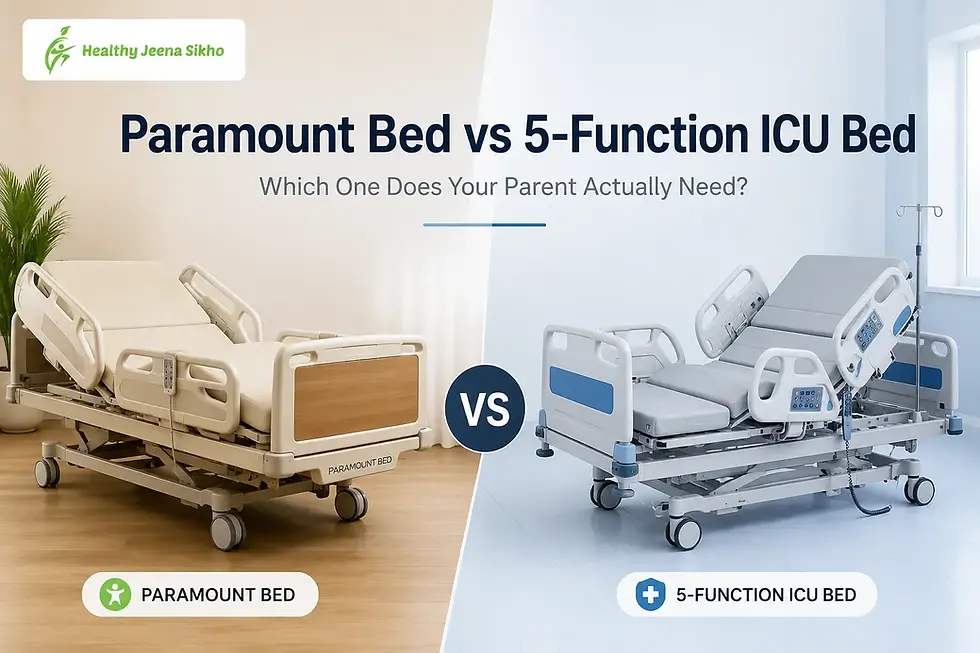
Q6.Can I use a tubular air mattress on a Paramount Bed or a 5-Function ICU Bed?
Yes. All three HJS tubular mattresses are designed to fit standard hospital bed frames, including Paramount Beds and 5-Function ICU Beds. Securing straps prevent displacement. Confirm your bed frame dimensions with our team at the time of ordering.
Shop Healthy Jeena Sikho's Tubular Anti-Bedsore Mattresses
All three products are in stock and available for same-day delivery at a special price of ₹9,000 (regular price ₹15,500).
Delivery cities: Delhi · Noida · Gurgaon · Faridabad · Ghaziabad · Chandigarh · Mohali · Ludhiana · Jalandhar · Lucknow · Jaipur
Not sure which mattress is right for your patient? Call +91 98769 78488 or WhatsApp us — our clinical team will recommend the right option in under five minutes, free of charge.
Summary: The One-Line Decision Guide for anti-bedsore air mattress vs foam mattress
Choose a foam mattress if your patient can shift their own weight, will be in bed for under 7 days, and has an active caregiver who can reposition them every 2 hours without fail — day and night.
Choose a tubular anti-bedsore air mattress if your patient is fully bedridden, has any existing skin redness or wound, has a solo or fatigued caregiver, or is entering prolonged recovery from a stroke, paralysis, COPD, or post-ICU discharge.
About Healthy Jeena Sikho
Healthy Jeena Sikho is India's trusted home medical equipment rental and sales company, serving over 1 lakh families since 2015. ISO 9001:2015 certified.
Stores across:
Same-day delivery. 24/7 support.
Shop Hospital Beds | Shop Mattresses | Call Us at +91 9876978488 | WhatsApp
SEO Metadata (paste into Wix SEO panel)
Page Title: Anti-Bedsore Air Mattress vs Foam Mattress: Which One Does Your Patient Need? | Healthy Jeena Sikho
Meta Description: Confused between an anti-bedsore tubular air mattress and a foam mattress? Expert guide with full comparison table, Braden Scale, condition-wise recommendations and real cost breakdown. Shop Olex tubular mattresses at ₹9,000 with same-day delivery across India.
Focus Keyword: anti-bedsore air mattress vs foam mattress
Secondary Keywords: tubular mattress for hospital bed, anti-decubitus tubular mattress India, bedsore prevention mattress, alternating pressure mattress price India, Olex tubular mattress, pressure ulcer mattress bedridden patient, tubular air mattress Delhi, anti sore mattress for hospital bed
Slug: /post/anti-bedsore-air-mattress-vs-foam-mattress
Category: Hospital Bed
Tags: bedsore prevention, tubular air mattress, foam mattress, pressure ulcer, hospital bed, anti-decubitus mattress, Olex mattress, home care, caregiver guide, bedridden patient care

This was an excellent and genuinely helpful article. I appreciate that it doesn't just list the differences between air and foam mattresses but explains how each option can affect comfort, pressure relief, and overall patient care. The practical examples make the information much easier to understand, especially for people choosing equipment for a loved one at home. While reading more resources on similar topics, I also came across https://cricket-betting.bet/. I found the site easy to navigate, with a clean layout that makes browsing straightforward and convenient.
What stood out most was the balanced approach throughout the article. Instead of suggesting that one mattress is always better, it explains when an anti-bedsore air mattress may be the right choice and when…
Managing long-term home care is incredibly stressful, and while I often browse platforms like https://1win-bd.org/ just to take a quick mental break during quiet hours, finding practical guides like this is a lifesaver. This breakdown between air and foam mattresses is highly detailed. For patients with zero mobility, the alternating pressure technology is absolutely essential to prevent tissue damage.
This article explains an important topic that many families overlook when caring for a bedridden patient. I found the comparison between a foam mattress and a medicated mattress very useful because it highlights how pressure ulcers can develop much faster than people expect. Many caregivers focus on medicines and daily care, but may not realize that pressure relief starts with the right sleeping surface. The explanation about Stage 1 redness progressing into serious wounds was easy to understand. I also appreciated the point that regular repositioning is difficult for many families, especially during the night. A medicated mattress with an alternating pressure system can help reduce continuous pressure on the same body areas. The details about airflow, skin protection, moisture…
This detailed breakdown makes choosing the right mattress for bedridden patients so much easier, and I’ll share this helpful guide alongside resources from kablora with other caregivers.